
Selecting the right lampshade is the defining factor that determines whether a table lamp looks like a designer centerpiece or an awkward, top-heavy mismatch. If a shade is even two inches too narrow, the hardware of your fixture remains glaringly exposed; if it is excessively tall, the lamp base appears swallowed and visually unstable. Mastering this balance does not require artistic guesswork—it relies on proven architectural formulas based on base height, belly width, and fitter geometry. This comprehensive lampshade size guide provides exact measuring methods, proportional rules, and hardware specifications to ensure your lighting looks perfectly balanced in any living space.
The Essential Lampshade Size Guide to Balanced Proportions
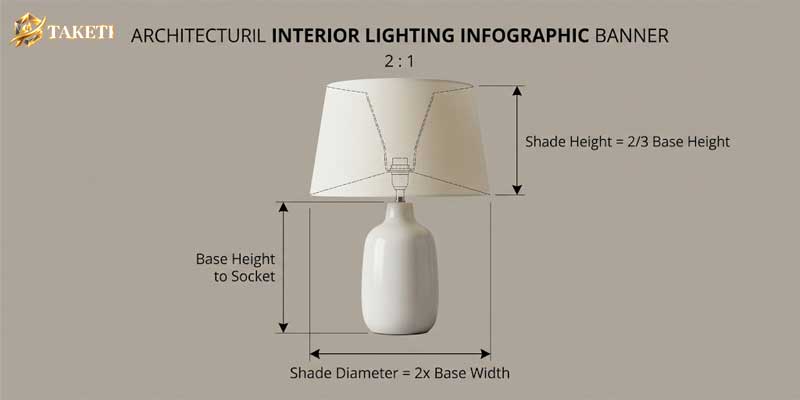
Before pulling out a tape measure, you need to understand the fundamental relationship between a table lamp base and its accompanying shade. In interior lighting design, visual weight is dictated by two primary rules that establish natural equilibrium.
1. The Two-Thirds Height Rule in This Lampshade Size Guide
The height of your lampshade should measure approximately two-thirds (60% to 70%) of the height of the lamp base. When measuring your lamp base, place your tape at the bottom surface resting on the tabletop and measure straight up to the bottom of the electrical socket. Do not measure to the top of the socket, the threaded rod, or the decorative finial. For example, if your ceramic base measures 15 inches tall up to the socket base, your ideal shade height falls between 9.5 and 10.5 inches.
2. The Twice-the-Width Diameter Rule
The bottom diameter of your lampshade should be roughly twice the width of the widest part of your lamp base. If you have an urn-shaped or gourd-style ceramic lamp that measures 7 inches across at its widest point, you should pair it with a shade that features a bottom diameter of 14 inches. Additionally, the shade rim should extend past the base footprint by at least 1.5 to 2 inches on each side to create a grounded, elegant profile.
How to Measure With This Lampshade Size Guide
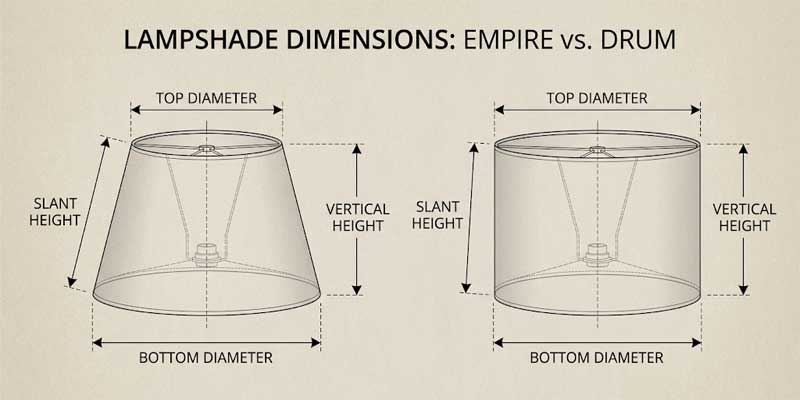
According to this practical lampshade size guide, shades are categorized by three distinct measurements: Top Diameter, Bottom Diameter, and Slant Height (or Vertical Height). Having these numbers recorded prevents costly ordering errors and returns.
1. Top Diameter
Measure straight across the upper circular or rectangular opening from outer edge to outer edge. On classic cylinder or drum shades, the top diameter matches the bottom diameter. On tapered drum, empire, or coolie shades, the top diameter is noticeably narrower to create a focused upward beam.
2. Bottom Diameter
Measure straight across the widest bottom opening from outer lip to outer lip. In commercial retail listings, when a lampshade is labeled simply by one number (such as a “16-inch shade”), that dimension almost universally refers to the bottom diameter.
3. Slant Height vs. Vertical Height
Always distinguish between slant height and true vertical height. Slant height is measured along the diagonal exterior slope of the shade, running from the top edge directly down to the bottom rim. Vertical height is measured perpendicular to the ground through the center cavity. For straight drum shades, both measurements are identical; for flared or cone-shaped shades, the slant height is always longer.
Lampshade Sizing Reference Chart
Use the dimensional reference chart below to match your table lamp base with standard commercially available shade sizes:
| Lamp Base Height (To Socket) | Ideal Shade Height | Ideal Bottom Width | Best Interior Application |
|---|---|---|---|
| 10″ – 12″ | 7″ – 8″ | 10″ – 12″ | Small nightstands, floating shelves, hallway nooks |
| 13″ – 15″ | 9″ – 10.5″ | 12″ – 14″ | Standard master bedroom end tables, office desks |
| 16″ – 18″ | 11″ – 12″ | 14″ – 16″ | Substantial sofa accent tables, large bedside tables |
| 19″ – 22″+ | 13″ – 15″ | 16″ – 18″+ | Living room credenzas, entryway consoles, floor lamps |
Matching Shade Profiles to Base Geometries
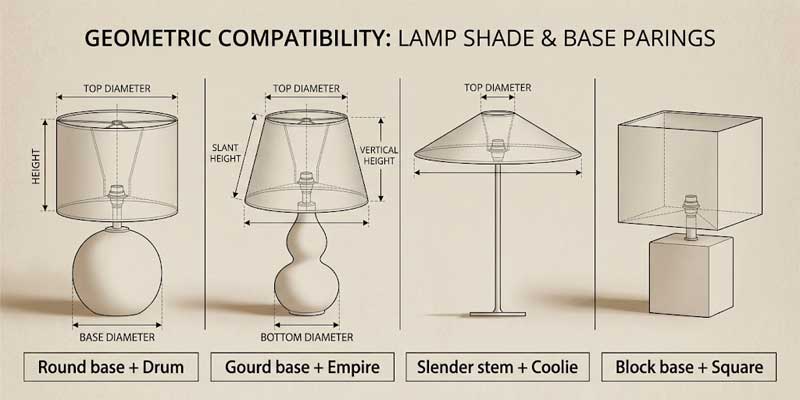
Achieving visual harmony requires matching the geometric character of your base with the silhouette of the shade, which remains a key focus in our lampshade size guide.
Curved and Sculptural Bases
Bases with soft, rounded contours—such as glass teardrops, ceramic gourds, and pottery urns—pair naturally with round shades. Empire, French drum, and tapered cone shades reinforce organic lines and maintain a gentle, continuous visual flow.
Angular and Architectural Bases
Square columns, rectangular brass stands, and geometric concrete bases require shades with defined edges. Square and rectangular box shades echo structural lines and prevent awkward overhangs, particularly when placed on narrow console tables flush against a wall.
Slender Stick and Candlestick Bases
Tall, thin metal bases need compact shades with a noticeable taper, such as coolie or shallow drum shapes. Avoid massive, heavyweight bell shades, as their visual mass overpowers a slender stem and creates an unbalanced top-heavy look.
Understanding Lampshade Fitters and Harp Hardware
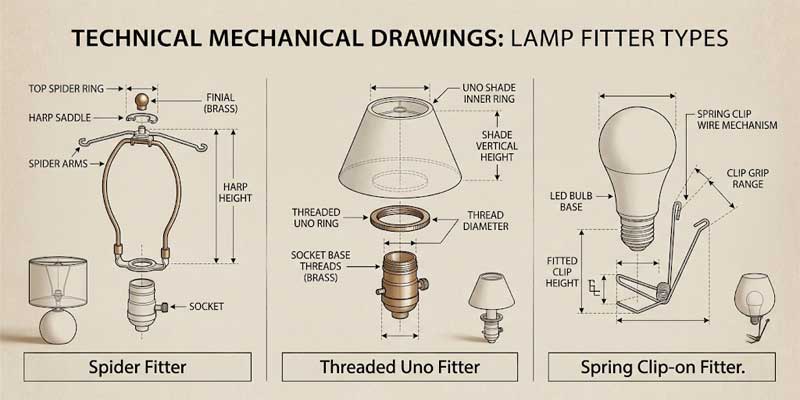
A lampshade can possess perfect physical dimensions according to our lampshade size guide, yet fail to sit properly if the mounting hardware is incompatible. American fixtures utilize three standard fitter types.
1. Spider Fitters (The American Standard)
The vast majority of US table fixtures utilize a spider fitter. It consists of three or four metal spokes connecting an outer rim to a small brass center ring (around 0.5 inches in diameter). This center ring rests directly atop the threaded post of a metal harp framework and is clamped down with a decorative screw-on finial. If your shade sits slightly too high or exposes the electrical socket, you do not need to replace the shade; simply swap your current harp for an 8-inch or 7-inch replacement harp to drop the shade profile instantly.
2. Uno Fitters
Frequently found on vintage European styles, bedside sconces, and smaller accent lamps. An Uno fitter features an integrated, larger threaded center ring (approximately 1.25 to 1.5 inches) that screws directly over the socket itself. Because Uno shades attach directly to the socket body, they do not require a separate harp or finial assembly.
3. Clip-On Fitters
Clip-on fitters use two spring-tensioned wire loops designed to clamp securely onto the rounded glass of a standard A19 or candelabra bulb. While convenient for miniature accent lights and chandeliers, clip-on shades should be paired exclusively with cool-running, energy-efficient LED bulbs certified by Energy Star standards to prevent heat damage or fabric discoloration over prolonged use. In addition, consulting guidance from the U.S. Department of Energy confirms that efficient LED bulbs minimize thermal buildup inside compact shades.
Material Selection: Translucent vs. Opaque Fabrics
The fabric construction of your shade dictates how ambient light distributes throughout the room. Evaluating fabric density is an essential step in this lampshade size guide.
Translucent Linen and Cotton
White, ivory, and natural linen shades allow light to filter out through the sides in a soft, 360-degree radius while casting bright upward and downward beams. This provides generous ambient illumination, making it the ideal choice for reading areas and ambient table lamps for living room spaces.
Opaque Paper, Metal, and Dark Silks
Opaque shades, such as black parchment lined with gold foil or solid spun brass, block light from escaping sideways. Instead, illumination is concentrated entirely into dramatic, theatrical cones from the top and bottom openings. These work best for dining sideboards, home bars, and dark accent corners where you desire focused mood lighting rather than broad ambient brightness.
Common Lampshade Mistakes to Avoid
Even seasoned decorators run into common pitfalls when fitting replacement shades. Keep these essential clearances in mind as outlined in this lampshade size guide:
- Exposed Sockets and Harps: When standing or seated in normal living positions, the bottom lip of your shade must completely cover the socket and switch. If the metal hardware shows, your shade drop is too shallow or your harp is too tall.
- Table Edge Overhang: A lampshade should never project past the physical perimeter of your table surface. Always leave at least 2 to 3 inches of open clearance between the outer rim of the shade and the edge of the tabletop to prevent accidental contact.
- Insufficient Bulb Clearance: Maintain a minimum distance of 2 to 3 inches between the bulb surface and the inside fabric wall of the shade. Restricting airflow around high-wattage bulbs creates dangerous heat retention and can scorch delicate fabrics.
Frequently Asked Questions About Lampshade Sizing
Can I change the height of my lampshade without buying a new one?
Yes. If your lamp uses a spider fitter, you can easily adjust the vertical positioning by replacing the metal harp. Harps are sold individually in half-inch increments (from 6 to 12 inches). Switching from an 9-inch harp to an 8-inch harp lowers the shade by one full inch, effortlessly hiding exposed sockets.
How do I calculate the shade width for a square lamp base?
Measure the diagonal width of the square base from corner to opposite corner, rather than measuring flat side to side. Following our lampshade size guide, choose a shade whose bottom diameter is approximately 1.5 to 2 times that diagonal measurement to prevent the corners of the base from visually protruding beyond the shade hem.
Which lampshade shape directs the most light downward for reading?
Flared shapes, such as classic Empire or Coolie shades, feature extra-wide bottom openings that direct maximum lumen output downward across your reading surface. In contrast, tall cylinder drum shades distribute light more evenly between the ceiling and tabletop.
