The Hidden Pitfalls of Generic Table Lamps: Addressing Modern Consumer Frustrations
Most residential buyers approach lighting selection strictly through a cosmetic lens—prioritizing an intriguing glaze, an on-trend silhouette, or a base hue that complements their accent pillows. Unfortunately, conventional retail marketplaces and mass-production supply chains prioritize manufacturing margins over fundamental photometrics. Consumers quickly discover that aesthetic allure without engineering rigor results in fixtures that compromise biological health, visual comfort, and mechanical longevity.
Invisible High-Frequency Flicker and Digital Eye Strain
The foremost optical defect in cheap portable luminaires is driver inadequacy. Inexpensive integrated LEDs and economy replacement bulbs utilize crude alternating-current (AC) rectifiers that modulate light output at 100 Hz to 120 Hz. While human optical vision cannot consciously register this hyper-speed stroboscopic cycling, the human retino-geniculate pathway processes every oscillation.
The Neurological Cost: Headaches and Asthenopia
When exposed to sub-conscious photometric ripple, the ocular ciliary muscles and pupillary sphincters are forced into involuntary, high-frequency micro-adjustments. After ninety minutes of sustained reading, writing, or keyboard work under inadequate drivers, users inevitably experience asthenopia—manifesting as ocular dryness, temple pressure, tension headaches, and degraded focus. High-performance table lighting must utilize continuous-current direct-current (DC) drivers that eliminate AC ripple entirely, satisfying strict IEEE 1789-2015 recommended practices.
Direct Glare, Inadequate Shielding, and Lumbar Misalignment
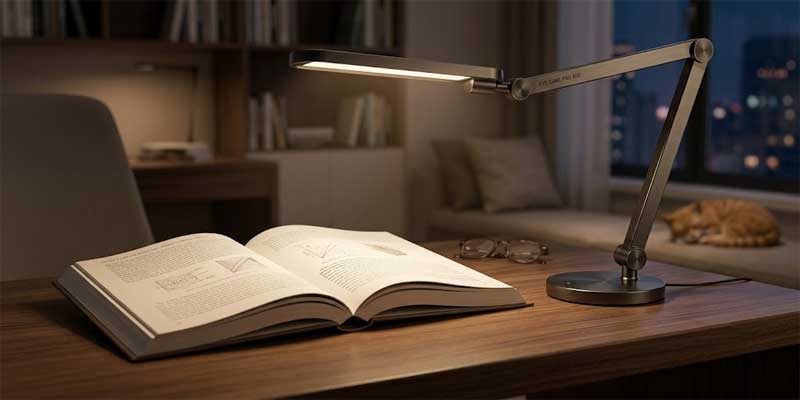
A widespread flaw in poorly designed lamps is incorrect shade geometry. If the lower rim of a lampshade sits elevated above seated eye level, or if the lamp body lacks an internal glare-suppression baffle, unshielded luminous flux radiates directly into the user’s peripheral field. Illumination engineers designate this condition as disability glare.
How Bad Lamp Proportions Disrupt Ergonomics
Confronted with direct peripheral glare, people instinctively squint, turn their head away from the light source, and slump forward to shield their eyes with their brows. Over prolonged periods of remote work or evening reading, this defensive posture leads to acute cervical spine stiffness, upper thoracic strain, and chronic lumbar compression. True ergonomic luminaires utilize precise cut-off angles and internal diffuser baffles that completely obscure direct line-of-sight to the light-emitting diodes.
Low Color Rendering Index (CRI) and Visual Desaturation
Generic mass-market lamps cut diode manufacturing costs by deploying phosphors that skip critical wavelengths, yielding poor Color Rendering Index (CRI / Ra) ratings below 80. This spectral deficit completely omits the R9 wavelength—the saturated red spectral band fundamental to rendering warm wood finishes, organic textures, natural textiles, and human skin tones. Rooms illuminated by low-CRI diodes appear washed out, greyish, and cold, inducing psychological unease and visual fatigue.
Why R9 and CRI 95+ Matter for Psychological Comfort
When an interior is bathed in full-spectrum illumination with CRI values of 95 Ra or higher (and R9 scores exceeding 80), colors achieve their true natural saturation. Architectural finishes regain optical depth, wood grains show rich character, and the entire residential interior provides an organic visual comfort that supports evening relaxation and lowers stress levels.
Unstable Bases, Tipping Hazards, and Cable Clutter
A continuous domestic irritation is an unsteady, top-heavy lamp that wobbles or falls over whenever a charging cord is bumped or an end table is brushed. Budget manufacturers routinely use hollow, ultra-light sheet metal or resin bases lacking internal counterweights. Furthermore, exposed, unweighted cables dragging off table edges create visual chaos and introduce tripping risks for families and pets.
Engineering Perfection: Critical Architectural Metrics for Every Table Lamp
Before investing in any table luminaire, evaluate its optical and structural properties against the following professional benchmark metrics. These standards delineate commercial-grade, architectural lighting from superficial retail novelties.
| Parameter | Budget Market Standard | TAKETI Architectural Standard | Direct User Benefit |
|---|---|---|---|
| Color Rendering (CRI / Ra) | < 75 – 80 Ra | ≥ 95 Ra (R9 > 80) | Renders true-to-life organic tones; restores room vibrancy and fabric depth. |
| Light Modulation (Flicker) | 10% – 30% AC ripple | < 0.5% (IEEE 1789 Compliant) | Completely eliminates sub-conscious optical fatigue, migraines, and reading strain. |
| Dimming Architecture | Single-step / 3-step switch | Stepless 5% – 100% Capacitive Touch | Adapts seamlessly from daytime precision tasking to ultra-gentle nocturnal ambiance. |
| Thermal Dissipation | Trapped plastic enclosures | Aviation Aluminum & Heavy Hardwoods | Prevents shade discolouration, keeps units cool to the touch, delivers 50,000h lifespan. |
| Base Mass & Balance Ratio | < 300g (Hollow plastic/tin) | Weighted Ballast (≥ 800g – 1500g) | Solid anti-topple stability, scratch-free padded bases protecting delicate tables. |
Understanding Photometric Ratios: Lux, Lumens, and Foot-Candles Explained
Many consumers mistake total luminous output (measured in lumens) for actual surface brightness (measured in lux). Lumens represent the total radiant energy emitted by the diode emitter in all directions. Conversely, lux measures the density of luminous flux falling across a specific square meter of physical work plane (1 lux = 1 lumen per square meter). In residential settings, a lamp producing 800 lumens inside an unfocused linen cylinder might yield less than 120 lux at tabletop level, creating insufficient reading contrast. Conversely, an engineered luminaire utilizing optical collimators can project an identical 800 lumens to achieve over 500 lux across an active desk mat without inflating thermal consumption.
Thermal Dissipation Dynamics and L70 Reliability Thresholds
Solid-state lighting fixtures generate substantial heat within the localized p-n junction of each LED diode. If junction temperatures climb above 85°C due to constrained internal ventilation or insulated plastic casings, three forms of catastrophic deterioration occur: color temperature drifting (where warm white shifts toward an unpleasant cold cyan), accelerated lumen depreciation (L70 lifespan reducing from 50,000 hours to fewer than 8,000 hours), and internal silicone lens clouding. Commercial-grade table lamps deploy die-cast aluminum heat sinks and CNC-machined alloy stems that passively channel thermal flux away from the emitter core, ensuring continuous lumen output throughout decades of service.
Strategic Room Deployment: Choosing the Ideal Table Lamp for Every Interior Zone
No single fixture architecture can accommodate every residential requirement. Coordinating an interior demands tailoring correlated color temperature (CCT), lux density, and shade geometry to the biological and practical needs of each functional living zone.
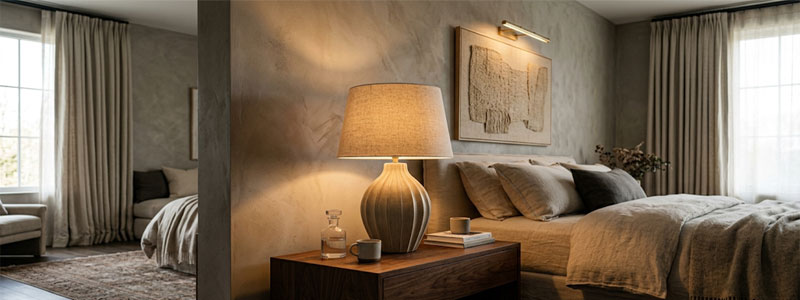
1. The Bedside Table Lamp: Sanctuary, Melatonin Preservation, and Relaxation
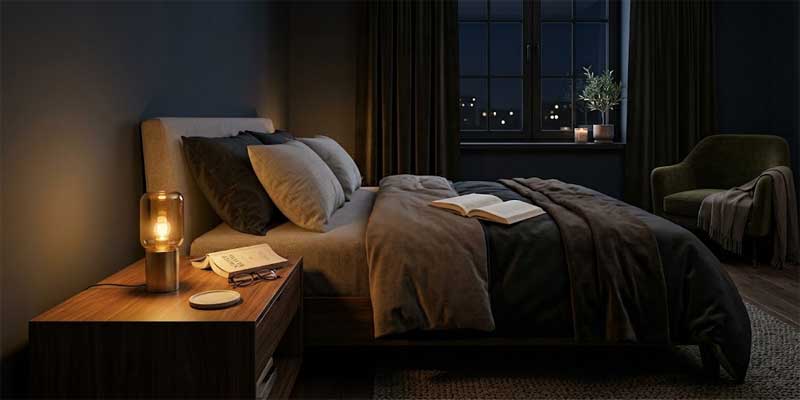
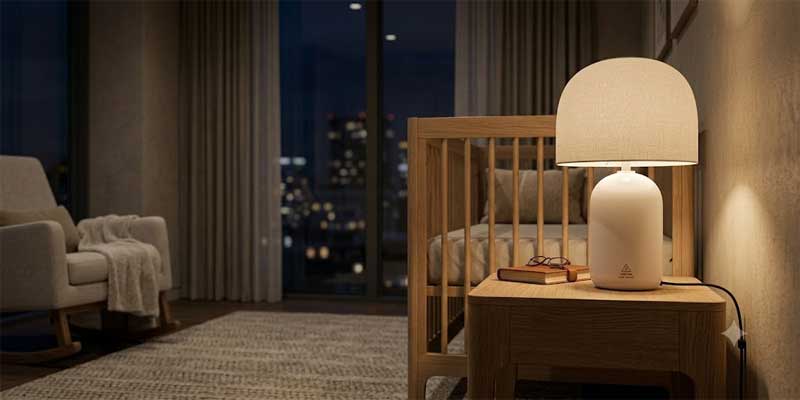
The biological role of bedroom illumination is preparing the neuroendocrine system for sleep. Exposing the human retina to high-energy visible blue wavelengths (450 nm to 480 nm) late in the evening suppresses the pineal gland’s secretion of melatonin, severely degrading sleep latency and restorative slow-wave sleep cycles.
Recommended Specifications for Nightstand Luminaires:
- Correlated Color Temperature (CCT): 2200K to 2700K (Candlelight Amber to Warm Soft White). This warm spectrum signals the brain that dusk has arrived, allowing the natural onset of sleepiness.
- Illuminance Density: 100 to 150 Lux for comfortable reading in bed; steplessly dimmable to under 15 Lux for late-night movement without shocking the eyes.
- Intuitive Touch Interface: Capacitive touch sensors positioned directly on the lamp base or stem, enabling effortless operation without searching for inline cord switches in the dark.
- Diffuser Engineering: Frosted core optics, solid crystal refractor spheres, or thick textured fabric shades that conceal bare bulb glare entirely.
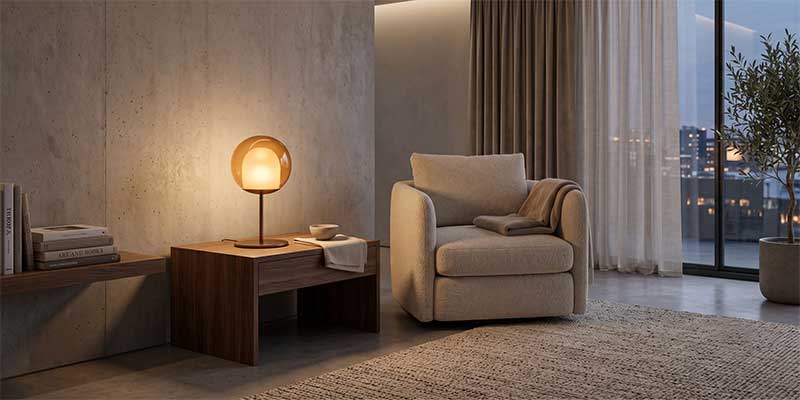
2. The Living Room Accent Lamp: Dimensional Layering and Hospitality
Living rooms suffer when lit solely by downward-firing recessed ceiling lights. Pot lights create stark, unattractive shadows beneath eyes, facial contours, and coffee tables, producing a flat, institutional atmosphere. Table lamps provide warm, mid-level horizontal lighting that bridges the floor and ceiling planes, creating depth and intimacy.
Key Living Room Styling Principles:
- The Golden Triangle: Arrange three lamps across the perimeter of the room at varying elevations to produce a soft, cohesive luminous envelope that makes spaces feel noticeably larger.
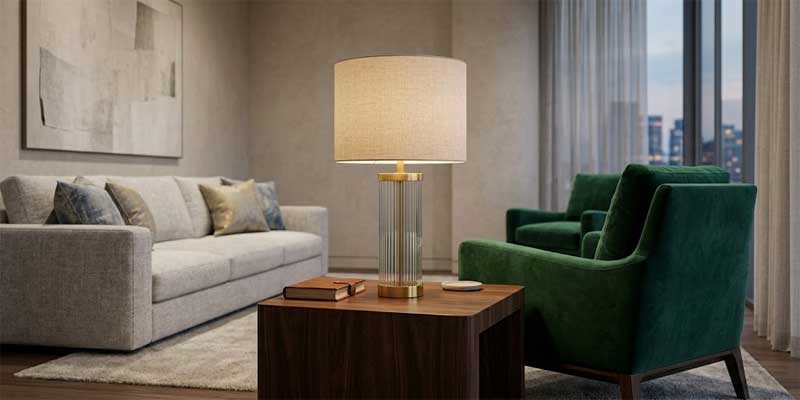
- Textural Balance: Balance hard architectural materials by choosing lamp bases crafted from fluted optical crystals, turned walnut woods, or brushed brass finishes.
- Harmonious Warmth (2700K – 3000K): Enhances the warmth of upholstery, linen curtains, and wood flooring while providing inviting illumination for conversation and leisure.
3. The Work Desk and Study Lamp: High-Contrast Task Precision
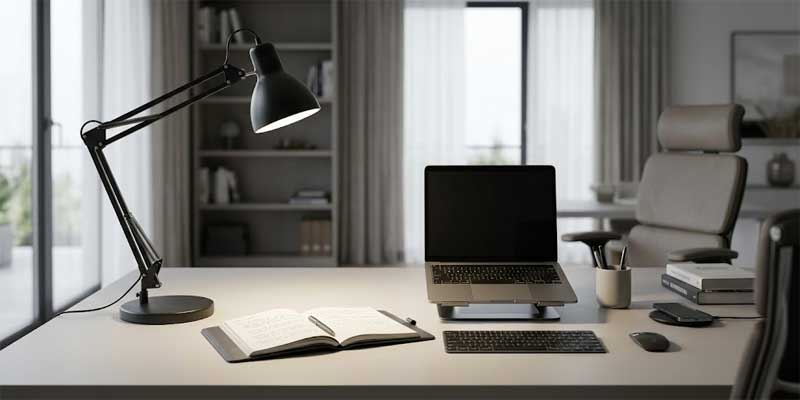
Dedicated home workstations and reading desks require targeted task illumination designed to minimize screen reflections while delivering crisp, shadow-free light across physical documents and keyboards.
Architectural Benchmarks for Productivity:
- CCT Transition: 4000K to 5000K (Crisp Neutral to Daylight White) to enhance cognitive focus and promote daytime mental alertness.
- Asymmetrical Optical Design: Directs the light pool forward onto the working surface, avoiding reflective bounce off computer screens and tablets.
- Articulated Adjustability: Counterbalanced tension joints that allow precise positioning of the lamp head without drooping or slipping over time.
4. Dining and Credenza Accent Lighting: Intimate Spatial Definition
Dining rooms and credenzas serve as conversational crossroads where lighting sets the entire mood of social hospitality. Overhead chandeliers frequently cast harsh downlighting across table centers, leaving peripheral credenzas, sideboards, and architectural alcoves trapped in shadowy obscurity. Flanking a dining credenza with a balanced pair of sculptured table lamps introduces soft perimeter backlighting that expands visual volume.
For credenzas, opt for tall, slender buffet silhouettes ranging between 28 and 34 inches in height. These elongated proportions cast light upward toward eye level when guests are standing, creating flattering fill light that softens facial shadows. Maintain correlated color temperatures between 2400K and 2700K with low-transmittance fabric shades or frosted internal glass cores. This establishes an intimate, candlelit ambiance that encourages guests to linger over dinner, transforming ordinary family dining into a curated restaurant experience.
Material Mastery: Why TAKETI Selects Optical Crystal, Solid Woods, and Precision Alloys
The structural longevity and tactile richness of any portable luminaire are dictated entirely by its fundamental material composition. While mass-produced commercial lamps utilize injected polycarbonates, hollow sheet-metal stampings, and synthetic glues that deteriorate within months under internal LED operating heat, authentic luxury demands raw, enduring physical substance.
Optic-Grade K9 Crystal: The Masterclass in Refraction and Light Transmission
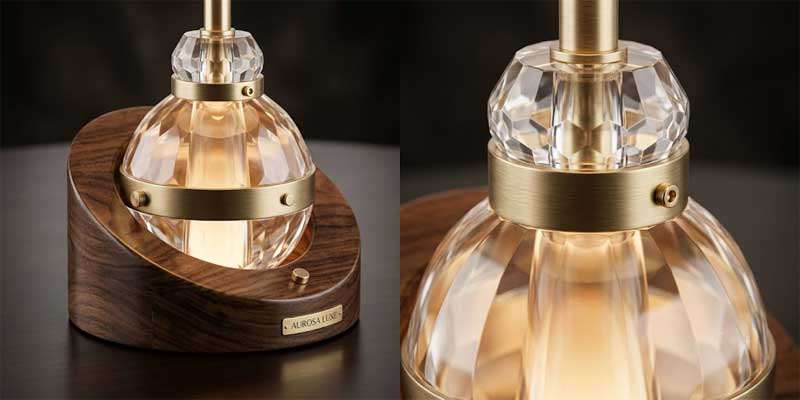
Unlike standard soda-lime glassware that displays air bubbles, greenish hues, and surface imperfections, genuine K9 optical crystal is refined under strict temperature controls and polished with industrial diamond wheels. When used in laser-engraved art luminaires, K9 crystal achieves a refractive index exceeding 1.51, bending light rays into an ethereal inner glow without creating harsh glare points.
Solid Turned Hardwoods: Thermal Buffering and Acoustic Warmth
Mounting an optical crystal sphere or hand-crafted shade onto a lathe-turned base of solid American walnut or natural beech introduces tactile luxury and essential stability. Hardwood serves as a natural thermal insulator and vibration dampener, keeping the fixture cool to the touch and resting quietly and securely on delicate marble or lacquered surfaces.
Anodized Brass and Powder-Coated Aviation Alloys
Articulated joints, touch sensors, and internal heat sinks demand durable alloys. Anodized aluminum conducts heat away from sensitive LED chips, keeping diode junction temperatures low and extending useful operating life past 50,000 hours—providing well over a decade of flawless performance.
Artisanal Ceramic Glazes and Textured Linen Weaves
Beyond structural alloys and optical crystal, premium table lamps integrate earthen ceramics and hand-loomed textiles to soften residential interiors. Commercial budget shades frequently utilize synthetic polyester laminates backed by flammable PVC sheets that turn yellow and crack under operational heat. Authentic artisanal shades incorporate open-weave Belgian linens, organic cottons, and parchment papers lined with fire-retardant styrene. These textured surfaces scatter luminous flux through micro-apertures, producing zero specular glare and lending organic warmth to surrounding walls.
The Definitive Sizing and Ergonomic Rulebook: How to Avoid Buying the Wrong Size
A frequent post-purchase disappointment occurs when an unboxed lamp overwhelms a slender nightstand or looks dwarfed beside a substantial sofa. Adhering to standard architectural sizing principles ensures proper visual proportion.
The Eye-Level Shade Rule
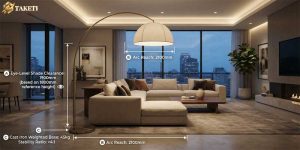
When seated next to your table lamp—whether resting in bed or seated on an armchair—the bottom edge of the lampshade should align between your chin and your eye level. It should never sit higher, which exposes the bare, dazzling light source, nor sit so low that it blocks light from falling onto your book or lap.
The 1/3 to 2/3 Height Proportion Metric
To establish visual balance between the lamp and its surface:
- Lamp Height relative to Table: The total height of the lamp should measure roughly 1.5 times the height of the accent table. For a 24-inch end table, choose a lamp between 28 and 32 inches high.
- Shade Diameter relative to Table Width: The widest point of the lampshade should never exceed the table’s width, leaving at least 2 to 3 inches of clearance on all sides to prevent accidental bumps.
- Shade Height to Base Proportion: The shade should represent approximately 35% to 40% of the lamp’s total vertical height, anchoring the piece with pleasing visual proportions.
Spatial Clearance and Radial Footprint Rules
A pervasive error in residential staging is crowding functional tabletops with oversized lamp bases. In ergonomic layout design, an end table or nightstand must maintain a minimum 60% open operational surface area after the lamp is placed. If a bedside table measures 20 inches in width by 18 inches in depth, the lamp pedestal must not exceed an 8-inch diameter footprint. Adhering to this ratio reserves ample physical space for vital personal items—such as water glasses, mobile devices, reading spectacles, and books—eliminating nighttime tipping hazards.
Safety, Low-Voltage Engineering, and Longevity Guarantees
Electrical safety is essential for portable appliances placed near beds, family seating, and pet areas. Poorly manufactured lamps often cut corners on safety certifications, posing risks of electrical shock, overheating transformers, and short circuits.
Low-Voltage 5V USB-DC Safe Currents
Modern residential table lamps, particularly compact bedside and decorative night lights, should utilize isolated low-voltage 5V DC power supplies. Stepping down 110V/220V household current through an external certified power supply ensures that the fixture itself carries only low-voltage DC, making it touch-safe, fire-resistant, and family-friendly.
Thermal Management and Anti-Discoloration Optics
Lamp shades often turn brittle or yellow near the top over time due to trapped radiant heat from inefficient light sources or poorly ventilated LED enclosures. Thoughtfully engineered luminaires feature dedicated thermal dissipation pathways, maintaining comfortable shade temperatures and preserving clean shade aesthetics for years to come.
Certification Standards: Understanding UL, CE, and RoHS Compliances
When selecting portable luminaires, verify that drivers and electrical sub-assemblies carry independent testing laboratory certifications. A UL-listed or ETL-certified luminaire has undergone rigorous testing protocols evaluating insulation dielectric resistance, mechanical stability under tilt angles up to 15 degrees, and maximum surface temperature rise under prolonged operation. RoHS compliance guarantees that internal solder joints, circuit boards, and metallic finishes remain entirely free of hazardous heavy metals such as lead, mercury, and hexavalent chromium.
Comprehensive Luminaire Care and Long-Term Maintenance
Maintaining the beauty and optical performance of premium table lamps requires simple, mindful care tailored to each specific material.
Cleaning Optical K9 Crystal and Precision Glass
To preserve glass brilliance, wipe crystal surfaces exclusively with a clean, anti-static microfiber cloth lightly misted with distilled water. Avoid harsh ammonia-based glass cleaners, which can degrade protective optical coatings over time.
Preserving Natural Hardwood Bases
Dust solid wood bases weekly using a dry, soft lint-free cloth. Once or twice a year, apply a small dab of natural beeswax or mineral oil to nourish the grain, prevent moisture loss, and preserve the deep satin finish of the wood.
Maintaining Metal Hardware and Articulated Joints
Clean brushed brass and anodized aluminum surfaces using a soft cloth dampened with mild soapy water, drying immediately with a fresh towel. Periodically inspect the tension screws on articulated lamps and tighten them gently with an Allen wrench if joints loosen over years of adjustment.
Shade Cleaning Protocols: Fabric, Paper, and Glass Diffusers
Lampshades act as electrostatic dust filters in home environments. For textured woven linen or pleated silk drums, clean weekly using a soft-bristle upholstery brush attachment on a vacuum set to low suction, or roll the exterior with an adhesive lint roller. Never saturate fabric or parchment shades with liquid detergents, as this causes water staining, glue delamination, and frame warping. Glass diffusers can be unmounted and washed with lukewarm water and mild dish soap before drying completely.
Smart Home Integration, Automation, and Modern Control Protocols
Modern residential lighting requires seamless connectivity with automated smart home ecosystems. Pairing table lamps with intelligent controls transforms static decor into responsive wellness lighting that shifts automatically throughout your daily schedule.
Triac Dimming vs. Pulse-Width Modulation (PWM) vs. Capacitive Sensing
Selecting the correct dimming mechanism is crucial for aesthetic and biological comfort. Conventional wall-mounted Triac dimmers work by slicing alternating-current phase waves, which frequently induces high-pitched acoustic buzzing and visible strobing when paired with budget LEDs. High-frequency Pulse-Width Modulation (PWM) cycling at rates above 25,000 Hz or stepless DC constant-current capacitive touch sensors embedded into metallic lamp stems provide perfectly silent, ripple-free dimming from 100% full illumination down to 5% nocturnal glow.
Automating Circadian Lighting with Smart Home Platforms
Integrating table lamps with platforms such as Apple HomeKit, Google Assistant, or Amazon Alexa unlocks automatic circadian scheduling. Program desk lamps to provide 4500K bright white light during core working hours to sustain dopamine and mental sharpness, then trigger an automated sunset scene that dims bedside and living room luminaires to a gentle 2200K amber. This hands-free shift prepares your nervous system for restful sleep every single evening.
Interior Design Showcase: Curating Layered Lighting Schemes
Interior decorators never rely on a single central luminaire to define a space. Achieving a magazine-worthy room requires orchestrating three distinct layers of light: ambient, task, and accent. Table lamps play an indispensable role in weaving these three layers into a cohesive visual narrative.
The Living Room Sanctuary: Layering for Warmth and Volume
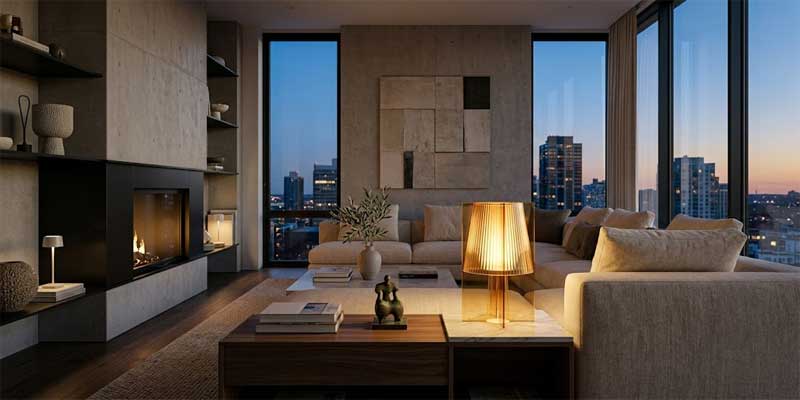
In a standard 15×20 foot living room, begin with subtle ceiling downlights dimmed to 30% to provide soft baseline ambient illumination. Next, place an articulated brass task lamp next to your primary reading armchair to deliver focused 300-lux task illumination across books without disturbing other occupants. Finally, place two sculptured optical crystal lamps on opposite end tables or sofa consoles to establish horizontal accent glow. This three-tiered layout eliminates shadows, emphasizes architectural boundaries, and creates an inviting retreat for evening entertaining.
The Master Bedroom: Creating a Serene Sleep Retreat
Bedrooms should evoke the serene comfort of a luxury boutique resort. Eliminate glaring overhead ceiling fixtures entirely in favor of dedicated perimeter table lighting. Position twin dimmable nightstand lamps with opaque fabric drums or frosted crystal cores on either side of the headboard. Positioned between 24 and 28 inches high, these bedside luminaires frame the bed as the visual anchor of the room while offering independent, glare-free illumination that lets one partner read comfortably while the other sleeps undisturbed.
Frequently Asked Questions: Consumer Concerns Resolved
Are LED table lamps truly superior to traditional incandescent fixtures?
Yes, provided the LEDs feature a high CRI (≥ 95) and constant-current drivers. Quality LEDs consume approximately 85% less energy than incandescents, emit negligible infrared heat, and provide stepless dimming without erratic color shifting.
Can a pair of table lamps sufficiently illuminate a bedroom without overhead lighting?
In most residential bedrooms, yes. Lighting designers frequently recommend eliminating central overhead lights in favor of layered accent and bedside lamps. This perimeter lighting approach creates a cozy, restful atmosphere ideal for unwinding in the evening.
What is the difference between Color Temperature (CCT) and Color Rendering (CRI)?
Color Temperature (measured in Kelvin) describes whether the light appears warm amber (2700K) or cool crisp white (5000K). Color Rendering (CRI / Ra) measures how accurately that light reveals the true, natural colors of objects compared to daylight. A lamp can be pleasantly warm yet still deliver exceptional color rendering.
Can these table lamps be connected to smart home outlets and timers?
Yes. Fixtures equipped with physical switches or memory-enabled touch drivers integrate seamlessly with Apple HomeKit, Google Assistant, or Amazon Alexa smart plugs, allowing you to automate subtle wake-up and wind-down lighting routines.
How do I know if my current table lamp suffers from high-frequency flicker?
A simple optical test can reveal aggressive driver flicker without professional laboratory equipment. Open the camera application on your smartphone, switch to video recording or slow-motion mode, set the frame rate to 120 fps or 240 fps, and point the lens directly at the illuminated lamp bulb from a distance of six inches. If dark, rolling horizontal bands or strobing lines sweep across your phone screen, the driver utilizes crude AC modulation. High-quality DC constant-current luminaires remain completely clear and stable across camera sensors at all frame rates.
What is the ideal lamp shade shape for directional reading vs. ambient room fill?
The geometric profile of a lampshade determines light distribution. A tapered empire shade features a narrow top opening and a wide bottom flare, channeling roughly 80% of luminous output straight downward onto tabletops for focused reading. In contrast, straight drum cylinders distribute luminous flux equally through both top and bottom openings while allowing soft lateral transmission through the fabric, making drum shades ideal for ambient accent lighting.
Why do some LED lamps emit an annoying high-pitched buzzing sound when dimmed?
Acoustic buzzing during dimming is typically caused by electromagnetic resonance inside budget inductors and transformers. When budget dimmers rapidly switch current on and off thousands of times per second (PWM chopping), internal mechanical coils physically vibrate against their housings, generating an audible 60 Hz hum. Architectural luminaires resolve this problem by encasing inductors in acoustic potting resin and utilizing pure direct-current analog dimming circuits that eliminate vibration.
Elevate Your Sanctuary: The TAKETI Lighting Promise
Residential illumination is an emotional, ergonomic, and aesthetic investment. When a table lamp combines optical-grade materials, full-spectrum color rendering, and stable engineering, it transcends utility to become a daily source of calm and visual delight. From detailed 3D optical crystal designs that introduce gentle celestial beauty to your nightstand, to adjustable task fixtures built for focused productivity, every piece in the TAKETI collection is crafted to eliminate visual strain, reduce harsh glare, and bring enduring craftsmanship into your home.
Transform your living spaces into a haven of balanced light today. Explore our curated collections above, experience the tactile luxury of solid hardwoods and optical crystal, and enjoy complete peace of mind with Free US Shipping and our dedicated satisfaction guarantee.