
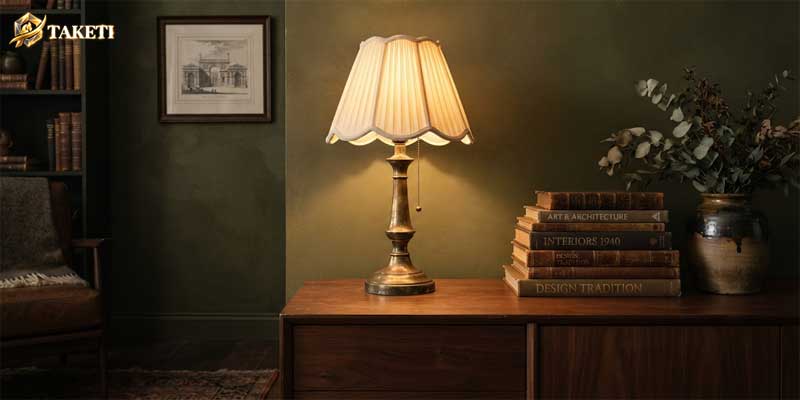
There is an undeniable tactile soulfulness in a genuine vintage lamp that modern assembly-line manufacturing simply fails to capture. From the weighty solid brass castings of late Industrial-era fixtures to the sculptural, glaze-dripped ceramic vessels of the 1960s, an authentic vintage lamp bridges architectural heritage with personal design expression. Instead of sterile symmetry, an aged heirloom introduces nuanced patina, organic irregularities, and a grounded sense of architectural permanence into residential interiors.
Yet bringing an authentic vintage lamp into a contemporary living space involves far more than casual thrift-store browsing. Discerning homeowners regularly encounter daunting technical and safety hurdles: hazardous cracked cords that trigger electrical breakers, oxidized socket collars that refuse to accept modern fittings, scorching heat build-up that damages irreplaceable antique parchment, and misleading mass-produced replicas masquerading as rare mid-century artifacts. Successfully selecting, restoring, and styling a vintage lamp requires an understanding of historical manufacturing techniques, meticulous electrical safety practices, and intentional interior composition.
The 4 Iconic Design Eras of the Vintage Lamp
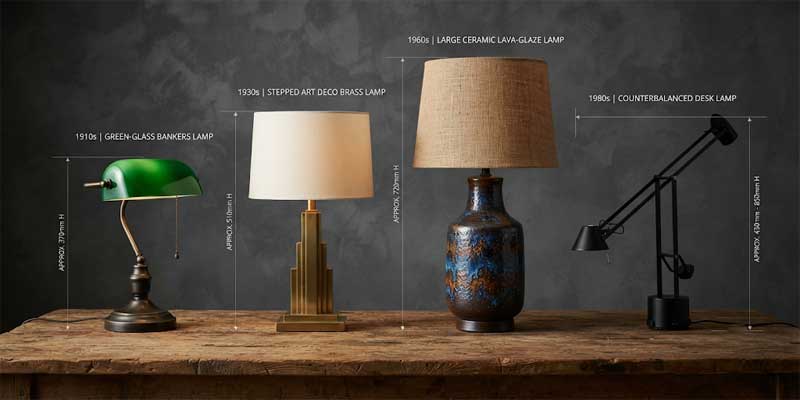
Understanding the architectural lineage of a vintage lamp allows you to verify historical authenticity and integrate the piece seamlessly into your home. Residential interior lighting over the past century divides into four iconic design movements:
1. Early Industrial & Banker Lighting (1900s–1920s)
Characterized by utilitarian cast iron, heavy unlacquered brass, and cased blown glass, this era gave birth to iconic functional staples like the Emeralite green-shade bankers lamp. Engineered for accountants and library reading rooms, these fixtures feature mechanical friction swivels, weighted cast-iron counterweights inside the base, and distinctive pull-chain switches. When examining an industrial vintage lamp from this period, look for heavy brass tubing with authentic tooling marks and rolled brass socket shells.
2. Art Deco & Streamline Moderne (1920s–1940s)
As decorative arts shifted toward machine-age geometric forms, lighting embraced stepped skyscraper silhouettes, polished chrome, polished nickel plating, and molded frosted glass. Art Deco table lighting frequently showcases stepped pedestals, stylized cast bronze figurines, and angular geometric accents. The metalwork feels substantial, and the detailing displays hand-chiseled crispness rather than the smoothed, rounded mold lines typical of modern stamped reproductions.
3. Mid-Century Modern & Space Age (1950s–1970s)
The post-war era democratized sculptural organic forms and playful optimism. Mid-century makers embraced spun brass saucers, teak woodwork, enameled perforated cones, and oversized hand-thrown ceramic bases finished in tactile lava glazes. Iconic designs by Stiffel, Rembrandt, and Laurel Lamp Company dominated mid-century American living rooms. A mid-century vintage lamp typically features long, sweeping brass necks or dynamic asymmetrical silhouettes paired with tall, drum-shaped shades.
4. Postmodern & 1980s Memphis Revival
Marked by bold geometric playfulness, high-gloss lacquered finishes, Memphis-style primary hues, and heavy black marble plinths, late-vintage lighting discarded mid-century minimalism in favor of theatrical statement shapes. Halogen task lamps with articulating counterbalanced arms gained massive popularity during this decade, bringing sharp lines and industrial precision to modern work desks.
Evaluating Provenance: How to Spot an Authentic Vintage Lamp vs. Faux Reproduction
The surging consumer demand for retro aesthetics has led to an influx of mass-market reproductions artificially distressed to look old. When inspecting a potential vintage lamp, check these four mechanical telltales to ensure you are investing in genuine vintage craftsmanship:
1. Base Weight and Material Honesty
Authentic fixtures produced prior to the 1980s were crafted from honest, high-density raw materials. Lift the lamp: solid brass, poured bronze, solid marble, and thick earthenware impart substantial physical mass. If a lamp feels suspiciously featherlight, it is almost certainly modern cast resin, polyurethane composite, or thin stamped sheet metal coated in chemical antiquing glaze. Scratches on authentic solid brass reveal shiny golden metal underneath; scratches on faux-antique reproductions expose grayish cast pot-metal or resin.
2. Hardware Fasteners and Screw Thread Profiles
Look beneath the felt base pad and examine the mechanical joinery connecting the stem to the socket assembly. Pre-1950s lighting was assembled entirely with single-slot flathead brass screws, square nuts, and threaded solid brass pipe. If you spot modern cross-headed Phillips screws, hex socket bolts, or melted hot-glue joints within the base casting, the fixture is either an outright modern reproduction or has been heavily patched with modern hardware.
3. Foundry Stamps and Paper Inspection Seals
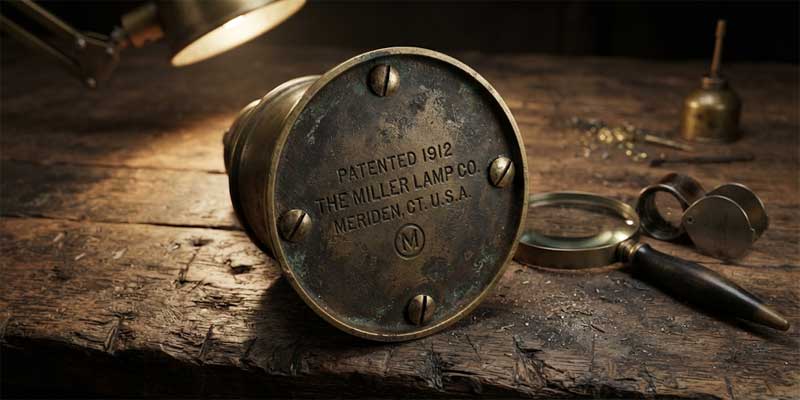
Renowned lighting foundries frequently cast their manufacturer names, model serials, or patent dates directly into the cast-iron base weights or internal brass collars. Inspect the inner rim of the base plate for raised lettering. Additionally, vintage lamps manufactured in North America after the 1930s often carry small blue or red Underwriters Laboratories (UL) inspection paper bands wrapped around the brass neck pipe or socket shell, confirming period authenticity.
4. Natural Oxidation vs. Artificial Patina
True metal patina develops organically over decades of handling and ambient air exposure. An authentic brass vintage lamp displays darker, tarnished oxidation around the base edge and neck joints, while the raised decorative ridges remain slightly polished from occasional handling. Modern distressing sprays, by comparison, appear unnaturally flat, uniform, and speckled across every surface without regard for realistic handling wear.
Critical Electrical Rewiring: Modern Safety for an Heirloom Vintage Lamp
While an antique ceramic base or cast-iron column can survive for generations, electrical wiring deteriorates rapidly. Operating an untreated vintage lamp with dried-out historical wiring introduces severe electrical shock and home fire risks. Follow this restoration protocol before plugging your vintage lighting find into an active wall receptacle:
1. Diagnosing Cord Degradation
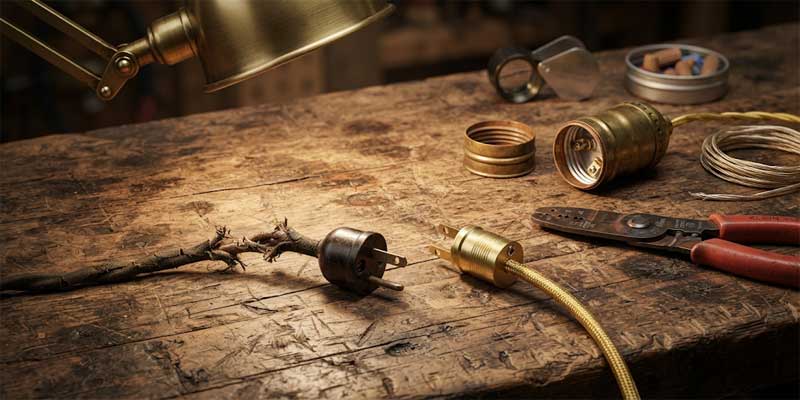
Early 20th-century rayon-sheathed and cotton-braided cords suffer from natural fiber dry-rot, leaving inner conductors exposed to airborne moisture. Mid-century rubberized lamp cords inevitably oxidize, harden, and crack upon bending, creating immediate short-circuit dangers. If the insulation feels stiff, flakes under finger pressure, or exposes bare copper strands, the cord must be decommissioned immediately.
2. Replacing Non-Polarized Plugs with Polarized Hardware
Original vintage fixtures utilized non-polarized two-prong plugs, where both copper prongs share identical dimensions. In modern electrical safety design, receptacles use polarized outlets where the wider neutral slot connects to the outer threaded screw shell of the socket, while the narrow hot slot feeds the internal base tab. Running an unpolarized vintage lamp means the exterior threaded collar of the socket can remain live even when the power switch is clicked off, shocking anyone who touches the socket while changing a bulb. Rewiring with a modern polarized plug eliminates this lethal hazard.
3. Rebuilding the Socket Core
Historic brass sockets frequently contain degraded cardboard insulating sleeves that dry out, crumble, and fail to isolate the electrical terminal screws from the exterior brass socket cap. Replace dried cardboard liners with modern heat-resistant insulating sleeves, or replace the entire internal socket interior with a brand-new UL-listed phenolic or glazed porcelain core while preserving the exterior antique brass shell.
| Electrical Element | Original Antique Condition | Modern Safety Code | Restoration Procedure |
|---|---|---|---|
| Main Power Cord | Frayed rayon wrap or cracked thermoplastic | SPT-2 rated wire with woven braid sleeve | Thread new 18-gauge braided antique-reproduction wire through base pipe |
| Wall Plug Blade | Symmetrical unpolarized brass blades | Polarized 2-prong blade design | Install polarized plug with neutral conductor wired to ribbed side of cord |
| Socket Insulator | Brittle, crumbling cardboard lining | Dielectric heat-rated vulcanized sleeve | Replace internal core with UL-listed ceramic or phenolic turn-knob socket |
| Base Weight Underside | Exposed oxidized cast iron or lead weight | Sealed non-conductive scratch barrier | Affix heavy density 3mm wool felt circle using spray contact adhesive |
Bulb Pairing: Preserving Fragile Vintage Lamp Materials from Heat Scorch
Traditional incandescent bulbs convert roughly 90% of their consumed electrical power into raw radiant heat rather than visible light. When fitted inside an antique vintage lamp, that extreme heat buildup wrecks irreplaceable components: it cracks fragile hand-painted porcelain, warps vintage fiberglass lampshades, and scorches delicate antique silk linings. Preserving your heirloom requires pairing it with modern LED technology tailored for historic aesthetics:
- Embrace Ultra-Warm Spectrum (2200K to 2400K): Avoid clinical 4000K daylight or bright cool 5000K bulbs. Authentic antique brass patinas, warm wood stems, and butterscotch art glass require an intimate, candlelight-adjacent warmth that softens metal reflections and creates rich evening shadows.
- Select Exposed Filament LED Bulbs: If your vintage lamp features an open-frame industrial shade or clear hurricane glass chimney, choose vintage-style LED filament bulbs. Modern amber-tinted LED filaments provide the romantic visual charm of early carbon-filament bulbs while drawing less than 6 watts of power.
- Eliminate Heat Degradation Completely: Modern LED fixtures run cool to the touch. By keeping heat away from antique parchment and silk liners, you effectively halt thermal degradation, extending the lifespan of your original shades indefinitely.
Restoring & Choosing the Perfect Lampshade for a Vintage Lamp
Nothing ruins the grandeur of a magnificent antique ceramic or bronze base faster than a modern, mismatched drum shade picked up haphazardly. Vintage fixtures demand specific shade proportions and complementary period-correct fabrics:
1. Matching Architectural Scale and Silhouette
Follow classic golden proportion principles: the height of your lampshade should measure approximately 60% to 70% of the base height (measured from the footpad to the socket base). For wide mid-century ceramic urn bases, seek flared coolie or empire shapes where the bottom diameter is at least twice the width of the base. For slender candlestick and art deco brass columns, choose bell-shaped, hexagonal, or pleated tapered cylinders.
2. Selecting Period-Authentic Shade Fabrics
Tailored knife-pleated shantung silk, nubby textured Belgian linen, and parchment paper with whipstitched edges deliver authentic historic credibility. If you own a 1950s space-age fixture, track down authentic mid-century fiberglass parchment shades featuring spun metallic flakes and retro atomic patterns to maintain era consistency.
5 Curated Interior Styling Ideas for an Authentic Vintage Lamp
An authentic vintage lamp serves as an exquisite visual counterpoint in clean, contemporary homes, softening sharp geometric lines and bringing character to curated rooms:
1. The Restorative Bedroom Sanctuary
Swapping out generic modern lighting for an authentic mid-century ceramic or aged brass fixture elevates your bedside into a tranquil retreat. Pair your historic lighting with curated Bedroom Table Lamps designed with warm linen shades to cast a soothing, glare-free amber glow that encourages deep evening relaxation.
2. The Modern Minimalist Living Room Sideboard
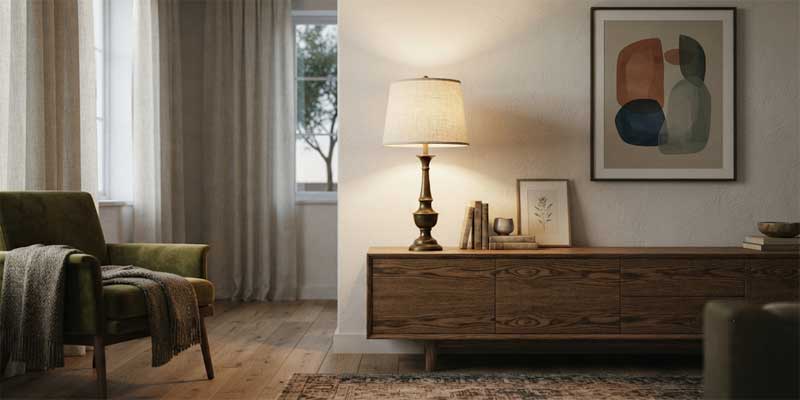
Create refined visual tension in a contemporary open-concept layout by setting an ornate Art Deco or mid-century vintage lamp atop a low, streamlined oak media console. To establish balanced illumination across extensive seating arrangements, coordinate your statement antique fixture with complementary Table Lamps For Living Room positioned across adjacent side tables.
3. The Atmospheric Executive Desk or Home Study
An authentic Emeralite bankers lamp or a solid brass articulating swing-arm lamp instantly anchors an executive home study. Positioned at the left corner of your writing desk, it directs a warm, concentrated pool of downward task illumination across work documents without washing out computer screens.
4. The Welcoming Heritage Entryway Vignette
Your foyer establishes the first sensory impression of your home. A tall, rewired antique candlestick lamp resting on a slender entryway console table—paired with an unlacquered brass key tray and framed vintage lithographs—greets family and guests with an inviting, golden atmosphere the moment they enter.
5. The Curated Dining Room Sideboard Arrangement
Flank an expansive dining room buffet or credenza with a matched pair of tall vintage brass lamps fitted with dark parchment shades. This arrangement provides subtle perimeter mood lighting that makes dinner parties feel warm and intimate without having to rely on blinding overhead chandeliers.
To browse a comprehensive collection of handcrafted ceramic fixtures, sculptural accents, and timeless lighting silhouettes crafted to enhance your home, explore the full catalog at Table Lamp.
Whether you uncover an authentic mid-century heirloom at an estate sale or inherit an antique family treasure, a thoughtfully inspected, safely rewired, and elegantly styled vintage lamp brings irreplaceable character, tactile history, and enduring warmth to any living space.
