
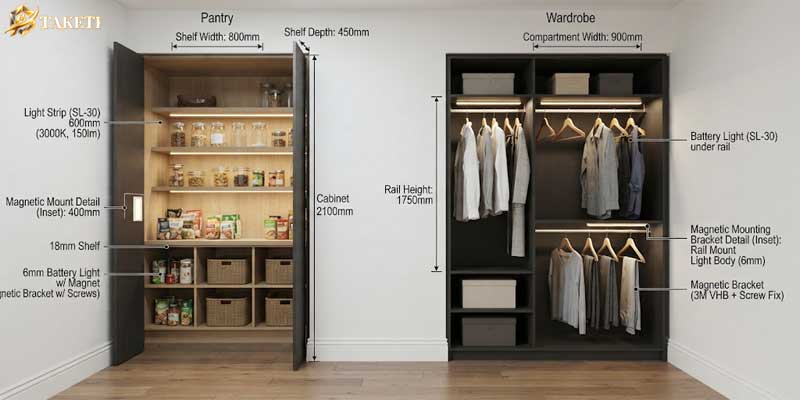
Adding architectural accent lighting once demanded extensive drywall cutting, tedious conduit fishing, and hefty electrical contractor invoices, but modern Battery operated lights have completely transformed how homeowners and renters approach dark spaces. From dimly lit pantry nooks and walk-in closets to floating bookshelves, these cord-free luminaires provide instant ambiance without altering existing wall framing. As a rapidly growing segment within contemporary LED Lights, high-efficiency battery operated lights offer immense design versatility. Yet, many buyers quickly find themselves frustrated by common pitfalls: pucks dropping off walls in the middle of the night, light output fading to a dull amber glow within hours, or getting trapped in a relentless, costly cycle of replacing disposable alkaline cells.
Maximizing cordless illumination requires understanding battery discharge curves, optical beam spread, and secure mounting mechanics. Just as choosing portable luminaires like cordless table lamps requires balancing battery capacity with daily usage, wall and cabinet fixtures demand thoughtful power management. By evaluating power chemistry, calculating authentic operational runtime, and implementing damage-free magnetic fasteners, your battery operated lights deliver reliable, museum-grade illumination in any room without running a single foot of wire.
Power Chemistry: USB-C Lithium-Ion vs. Disposable AA Alkaline
The single greatest factor governing your long-term satisfaction with battery operated lights is the underlying battery chemistry. The market is largely split between legacy dry-cell units and modern integrated lithium-ion systems.
1. Disposable Alkaline Batteries (AA and AAA Cells)
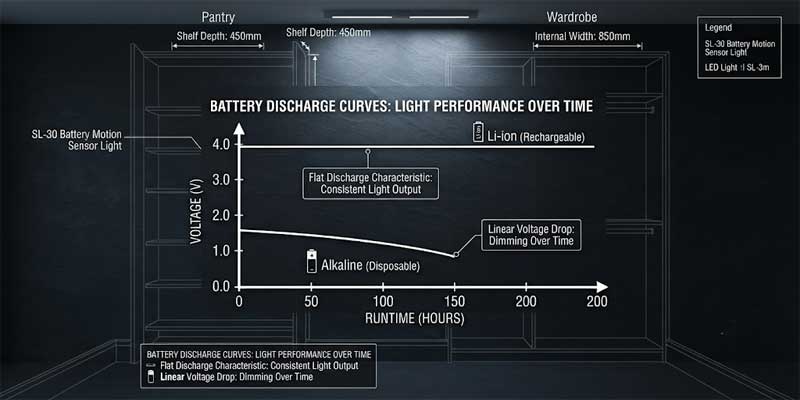
Fixtures powered by standard AA or AAA batteries carry a low upfront purchase cost, but they introduce steep ongoing maintenance expenses. Alkaline chemistry exhibits a sloped discharge curve: as the battery drains, its delivery voltage drops continuously from 1.5 volts down to 0.9 volts. This means your battery operated lights begin losing brightness almost immediately, operating at less than 50% of rated lumen capacity for the second half of their battery life. Furthermore, leaving depleted alkaline cells inside fixtures risks acidic potassium hydroxide leaks that corrode electronic contact springs.
2. Integrated Rechargeable Lithium-Ion Cells
Modern wireless fixtures utilize rechargeable lithium-polymer or 18650 lithium-ion cells with integrated USB-C charging ports. Lithium chemistry delivers a flat, regulated voltage discharge curve, ensuring premium battery operated lights maintain consistent, peak lumen output until stored energy is roughly 95% depleted. Equipped with internal overcharge and short-circuit protection boards, rechargeable fixtures eliminate battery landfill waste and allow you to quickly replenish power using standard mobile phone wall chargers or portable power banks.
| Feature | Disposable AA / AAA Alkaline | Integrated USB-C Lithium-Ion |
|---|---|---|
| Voltage Stability | Steep decline (light dims steadily) | Flat regulated curve (constant brightness) |
| Annual Operating Cost | High ($30 – $60 per year in replacement cells) | Near zero (pennies per recharge cycle) |
| Corrosion Hazard | High risk of chemical leakage over time | Sealed cells with zero terminal leakage |
| Environmental Footprint | Frequent heavy-metal battery disposal | Reusable across 500+ charge cycles |
Decoding Realistic Runtime on Battery Operated Lights
Retail packaging for battery operated lights frequently boasts deceptive claims such as “100 Hours of Continuous Run Time.” In reality, these metrics represent the duration until the diode completely extinguishes, not the timeframe of usable task light.
1. Usable Lumen Decay
A standard puck light rated at 80 lumens draws roughly 0.8 to 1.2 watts of power. Operating on three standard AAA batteries (providing roughly 3.6 to 4.0 watt-hours of total capacity), the fixture can only sustain its full 80-lumen output for approximately 3 to 4 hours. Beyond that initial window, the output rapidly drops below 20 lumens—providing faint nightlight visibility rather than active kitchen counter or task illumination.
2. The True Runtime Formula
To accurately project how often you will need to recharge your battery operated lights, calculate the total battery capacity in milliamp-hours (mAh) against the fixture’s power draw:
Operating Hours = Battery Capacity (mAh) / Operating Current Draw (mA)
A high-capacity 2000mAh rechargeable fixture drawing 200mA at medium brightness will deliver roughly 10 hours of continuous light. If activated via motion sensors for 60 seconds twenty times per day, that single charge will comfortably last over 30 days of real-world household use.
Smart Activation: PIR Motion Sensors vs. RF Remote Controls
How you trigger your wireless fixtures dictates both convenience and battery longevity. Manual push-button caps require physical contact, which often leads to oily fingerprints on fixtures and dislodges adhesive wall mounts over time.
1. Passive Infrared (PIR) Motion Detection
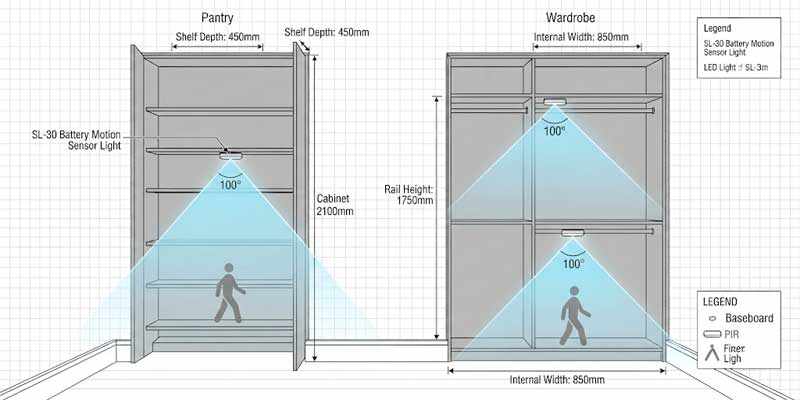
PIR sensors detect moving heat signatures from human bodies within a 100-degree arc up to 10 feet away. High-performance battery operated lights pair PIR with an integrated daylight lux sensor, preventing the fixture from activating when ambient room light is already sufficient. Incorporating automated 20-second or 60-second shut-off timers ensures the fixture never drains its battery in an empty room, making it the premier choice for dark stairwells, utility pantries, and deep dresser drawers.
2. Radio Frequency (RF) Multi-Unit Remotes
Unlike infrared remotes that require direct line-of-sight to each fixture, 433MHz or 2.4GHz RF remotes penetrate cabinet doors and furniture panels. A single master remote allows you to simultaneously switch, dim, and set countdown sleep timers for an entire bank of up to 12 fixtures across a room. This setup is ideal for accentuating floating display shelves or curio cabinets where synchronized group control is required.
Renter-Safe Mounting for Battery Operated Lights
The most common failure point for wireless lighting is physical mounting detachment. Smooth double-sided foam tape inevitably dries out under heat or pulls paint layers away from drywall when removed.
1. Magnetic Backplates and Steel Adhesive Discs
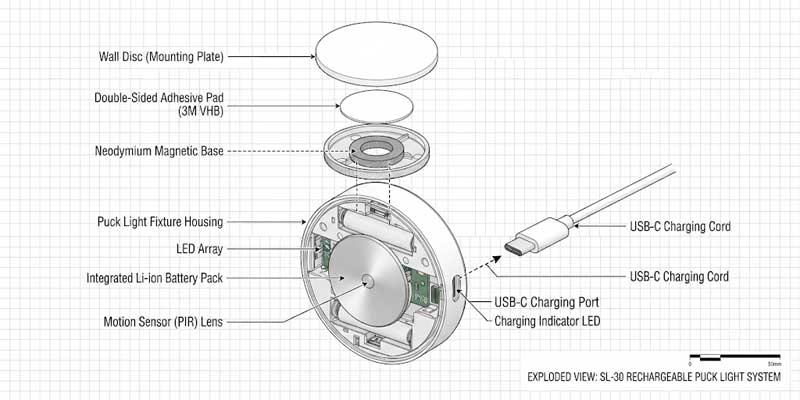
Quality battery operated lights utilize built-in neodymium rare-earth magnets inside their base housing. The mounting kit includes thin steel receiver plates equipped with peel-and-stick adhesive. You adhere the steel plate to the wall or cabinet stile, allowing the light body to snap magnetically into place. This allows you to effortlessly detach the fixture whenever it requires recharging via USB cable, completely eliminating mechanical stress on your wall adhesive.
2. Drywall Surface Preparation
Before applying adhesive discs to painted drywall, unfinished wood, or laminate cabinet undersides, thoroughly clean the surface using a 70% isopropyl alcohol wipe. Avoid household surface cleaners, which leave oily surfactant residues that weaken synthetic adhesives. For textured or chalky flat latex walls, secure the magnetic base plate using a single countersunk flathead wood screw rather than tape alone.
Layering Wireless Fixtures with Ambient Accent Lighting
While wireless pucks and compact linear bars excel at targeted illumination inside enclosed utility cabinets and display shelving, they should never serve as the sole source of illumination in primary living quarters. Relying solely on localized directional spotlights creates high visual contrast that strains the eyes during evening hours.
Pairing functional under-shelf lights with a warm, sculptural Table Lamp on an adjacent console balances functional direct beams with soft omnidirectional room glow. This multi-layered lighting approach creates depth, softens hard shadows, and allows your living space to seamlessly shift from task-focused meal preparation to cozy, relaxed evening lounging.
By investing in regulated USB-C lithium-ion batteries, sizing capacity to realistic daily usage patterns, and utilizing magnetic mounting plates, you can ensure your battery operated lights deliver flawless cordless illumination for years to come.

Pingback: Motion Sensor Light: 5 Pro Rules to Pick, Wire & Set Right