
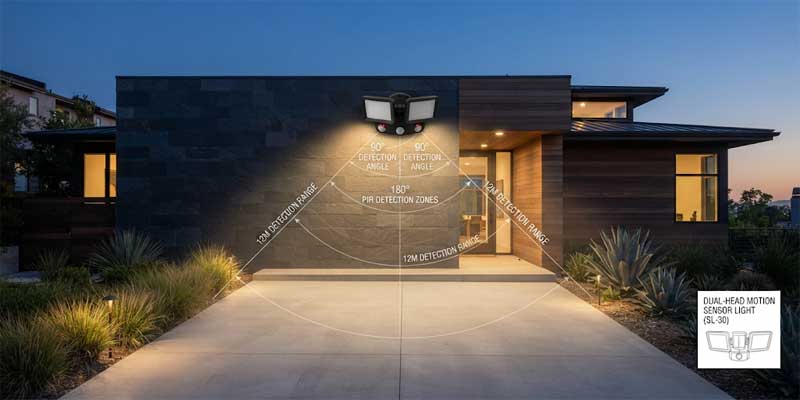
Few lighting upgrades combine perimeter security and everyday convenience quite like an automated Motion sensor light. Whether illuminating a dark driveway as your vehicle pulls in or guiding nighttime footsteps down a dim staircase, hands-free fixtures bring functional safety to residential properties. As an essential segment of modern exterior and interior LED Lights design, motion-activated luminaires eliminate stumbling in the dark while significantly lowering household electrical waste. Yet, homeowners routinely face aggravating headaches: security fixtures triggering randomly in the wind, units staying lit all day, buzzing wall sensors, or lights blinding neighbors across the fence.
Achieving a reliable installation requires pairing the right fixture category with precise optical calibration and proper electrical load management. While simple utility spaces benefit from compact fixtures like Battery operated lights inside pantries, exterior entries and high-traffic corridors demand specialized engineering. Understanding the distinct types of fixtures on the market and mastering sensor mechanics ensures your motion sensor light provides instant, dependable visibility exactly when you need it without nuisance false alarms.
Choosing the Right Motion Sensor Light for Your Home
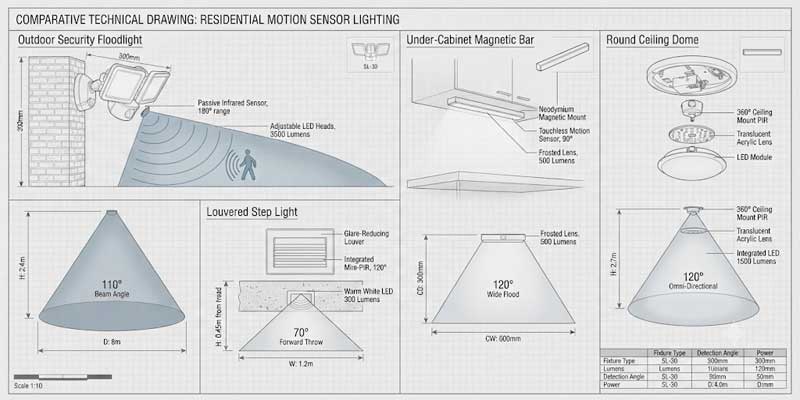
Selecting the best motion sensor light starts with identifying the specific functional demands of each area. The market features four distinct fixture formats engineered for residential applications:
1. Exterior Security Floodlights
Exterior security floodlights represent the primary line of defense for driveways, backyards, and side alleyways. These heavy-duty fixtures typically feature two or three independently articulating LED lamp heads producing 1,500 to 3,000 lumens. High-grade models utilize rugged die-cast aluminum housings with an IP65 weatherproof rating to withstand severe rain, snow, and extreme heat. They feature an integrated wide-angle sensor mounted beneath the lamps, designed to saturate wide outdoor perimeter zones with crisp, high-visibility illumination.
2. Low-Profile Step and Hallway Nightlights
Interior walkways, stairwells, and baseboards require subtle guidance rather than blinding security beams. Step and corridor fixtures deliver soft, downward-directed washes (typically 30 to 80 lumens) shielded by horizontal louvered faceplates. These fixtures prevent nighttime eyestrain when walking to the kitchen or bathroom. Available in low-profile plug-in formats or flush-mounted electrical box designs, they operate on warm 2700K color temperatures to preserve night vision and avoid disrupting sleep cycles.
3. Magnetic Under-Cabinet and Wardrobe Sensor Bars
Closets, pantries, and kitchen prep corners frequently lack hardwired junction boxes. Ultra-slim sensor light bars solve this challenge by utilizing built-in rechargeable lithium batteries and magnetic mounting backplates. These fixtures activate instantly when a cabinet door opens or a hand reaches beneath a shelf, automatically powering down after 20 to 30 seconds of inactivity. Their adhesive magnetic brackets allow you to detach the fixture effortlessly whenever USB recharging is needed.
4. Flush Ceiling Luminaires for Garages and Laundries
Garages, utility basements, and laundry rooms demand broad, overhead coverage when entering with full arms. Flush-mounted ceiling fixtures feature integrated 360-degree detection domes positioned in the center of the lens. These hardwired fixtures cast a wide, omnidirectional wash of 4000K neutral white task light, replacing obsolete pull-chain fluorescent ballasts with immediate, high-efficiency illumination.
| Fixture Category | Lumen Output | Detection Angle | Primary Application |
|---|---|---|---|
| Security Floodlights | 1,500 – 3,000 Lumens | 180° – 270° | Driveways, detached garages, yard perimeters |
| Louvered Step Lights | 30 – 80 Lumens | 100° – 120° Downward | Stair risers, dark hallways, baseboards |
| Wireless Cabinet Bars | 100 – 250 Lumens | 100° – 120° | Walk-in closets, kitchen counters, pantries |
| Flush Ceiling Fixtures | 800 – 1,800 Lumens | 360° Downward Cone | Garages, laundry rooms, storage utility closets |
Sensor Technology: PIR vs. Microwave Motion Sensor Light
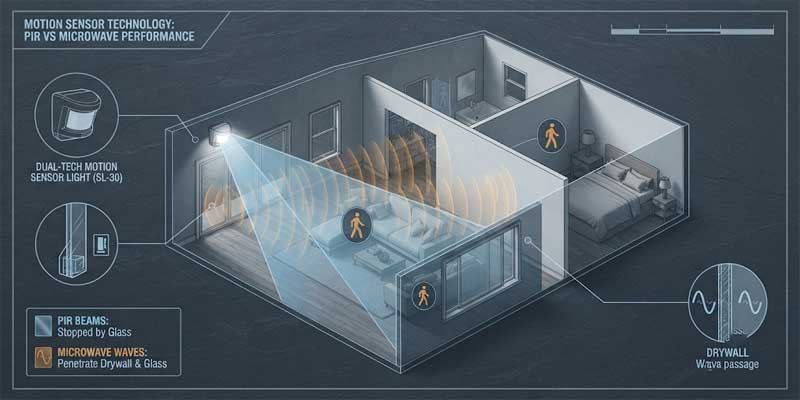
The operational reliability of any motion sensor light relies on its internal detection engine. Most modern fixtures utilize one of two competing sensor technologies:
1. Passive Infrared (PIR) Sensors
PIR sensors operate by monitoring ambient thermal radiation across segmented optical zones. When a warm human body or vehicle engine moves across these zones, the sensor detects the rapid shift in temperature and closes the circuit. PIR optics cannot penetrate solid physical barriers such as glass windows, drywall, or wooden fencing. This makes a PIR motion sensor light the preferred option for residential outdoor yards and bedrooms, as it prevents movement inside the house or across property lines from triggering the fixture.
2. Microwave and Radar Sensors
Microwave sensors emit continuous high-frequency electromagnetic pulses and measure the return reflection. Any moving object altering the wave pattern trips the light. While microwave sensors are exceptionally sensitive and detect subtle hand gestures, their radio waves effortlessly penetrate glass, plastic, and non-metallic partition walls. Installing a microwave motion sensor light outdoors or near bedroom walls frequently causes annoying false triggers from passing street traffic or interior family movements.
Eliminating False Triggers and Unwanted Activation
A poorly configured motion sensor light that triggers constantly strains neighbor relations and wastes energy. Mitigating nuisance tripping requires addressing common environmental factors:
1. Sensor Aiming Geometry
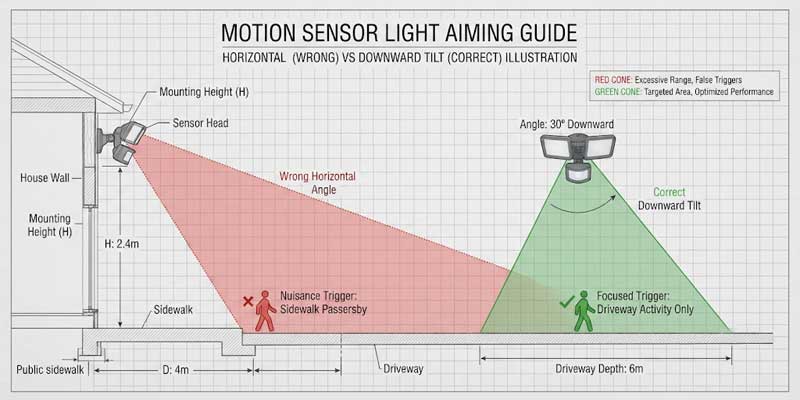
Installers frequently mount outdoor fixtures parallel to the horizon, allowing the sensor to gaze directly into street traffic or swaying tree branches. Always angle the sensor dome slightly downward toward your property line. This focuses the field of detection onto your driveway pavement and entry stairs while keeping distant foliage and public sidewalks outside the sensitive trigger zone.
2. Thermal Turbulence and HVAC Exhausts
Because PIR sensors look for sudden temperature differentials, installing your motion sensor light near dryer vents, exterior air conditioning condensers, or gas furnace flues guarantees erratic behavior. Expanding plumes of hot exhaust mimic moving human heat signatures. Maintain at least 6 to 8 feet of physical separation between thermal air discharge points and your sensor optics.
3. Optical Masking Techniques
If your installation space borders a busy public sidewalk, you can mechanically block peripheral visibility. Apply thin, opaque electrical tape or manufacturer-provided clip-on plastic louvers over the left or right edge of the Fresnel sensor lens. This effectively blocks peripheral angles while preserving full forward sensitivity.
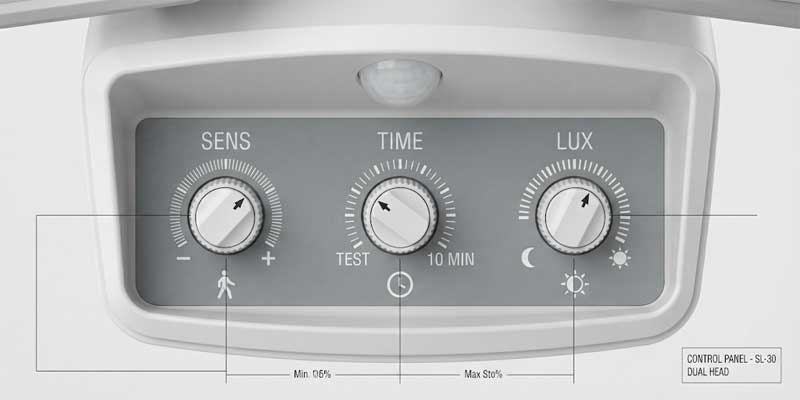
Calibrating the Three Hardware Dials: SENS, TIME, and LUX
Quality motion sensor light units feature three manual adjustment potentiometers on the bottom of the sensor housing. Tuning these dials properly ensures trouble-free performance:
- SENS (Sensitivity/Range): Controls the physical detection reach, typically adjustable from 10 feet up to 50 feet. For suburban properties, turn the dial down to medium (around 20 to 25 feet) to avoid picking up neighborhood dog walkers.
- TIME (Delay Duration): Dictates how long the lamp remains illuminated once movement ceases. For quick path guidance, a 1-minute to 2-minute setting is ideal. For workspace areas like garages or loading pads, set the timer to 5 or 10 minutes to prevent the light from clicking off while you work.
- LUX (Daylight Sensor): Sets the ambient darkness threshold required before the motion sensor can engage. Turn this dial fully toward the moon icon so your motion sensor light remains dormant during daylight hours, saving energy until genuine dusk arrives.
Hardwiring and Manual Override Control
Hardwired line-voltage (120V) fixtures provide permanent security and superior power reliability. Proper installation requires mounting the fixture to a round, weatherproof electrical junction box sealed with silicone caulk along the top and side flanges.
Most premium security fixtures include an internal “Manual Override” function. If you need steady illumination for an evening backyard gathering or car repair session, flip the controlling indoor wall switch off and immediately back on within 1 to 2 seconds. This bypasses the motion sensor light module, forcing the LEDs to stay continuously lit. Flipping the switch off for 10 seconds resets the unit back to automated motion detection mode.
Pairing automated safety lights along home perimeters with inviting ambient accents like a handcrafted Table Lamp inside entry foyers creates a warm, multi-layered visual transition from exterior security to interior relaxation.
By selecting the right fixture profile, shielding sensors from thermal exhausts, and fine-tuning sensitivity dials, your motion sensor light delivers unmatched convenience, certified electrical safety, and flawless security for years.
