
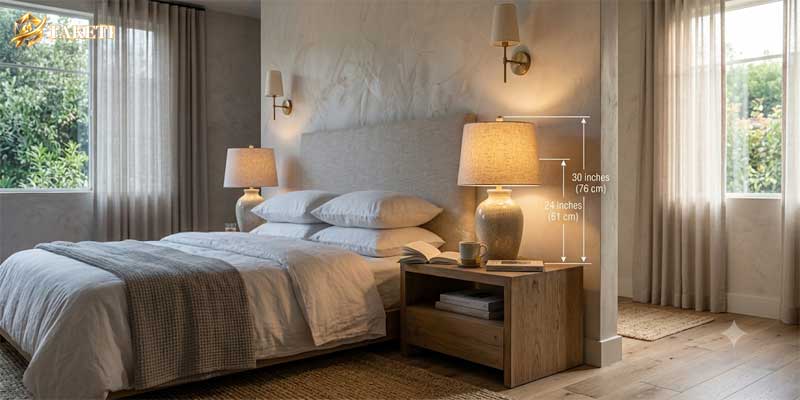
Finding the correct bedside lamp height comes down to one precise measurement: your lamp should stand between 24 and 30 inches (61 to 76 cm) tall from the nightstand surface to the top of the finial. If your nightstand is taller than average, pick a fixture closer to 24 inches; if your table sits low, choose a lamp reaching 28 to 30 inches. The combined height of your mattress, table, and lamp must align so that the lower rim of the lampshade rests level with your chin when you sit upright in bed. This eliminates direct bulb glare while casting an optimal pool of illumination across your bedside reading area.
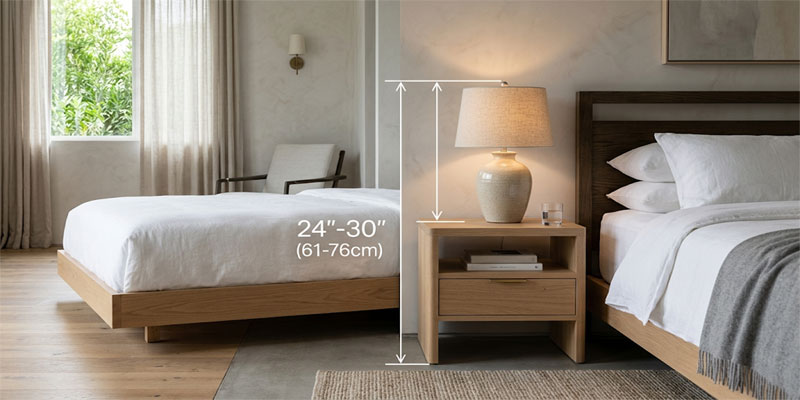
The Eye-Level Golden Rule: Why Sitting Height Dictates Lamp Height
The single biggest mistake in bedroom lighting design is purchasing a fixture based on its standalone appearance rather than how your body interacts with it while resting. Your posture in bed determines where the light source must reside to prevent eyestrain.
The Sitting Chin-to-Eye Alignment Test
When you prop yourself up against your pillows or headboard to read, unwind, or scroll through your phone, the bottom edge of your lampshade should align horizontally with your chin or cheekbones. This spatial alignment serves two crucial functions:
- Glare Prevention: It shields your retinas from direct exposure to the exposed bulb base and socket hardware.
- Effective Downward Beam: It directs the broad cone of light downward onto your lap, book, or bedside table rather than outward into your eyes.
If the shade rests above your eye level, every glance toward the nightstand exposes your eyes to harsh raw filaments. If the shade sits below your shoulder line, your torso casts a dark shadow directly across your lap, defeating the entire purpose of task lighting.
How to Take Your Sitting Measurement Before Buying
Do not guess dimensions while browsing online stores. Follow this straightforward test to establish your exact baseline:
- Sit upright on your mattress in your natural lounging or reading posture.
- Have someone place a standard measuring tape on the top surface of your nightstand.
- Extend the tape upward until it aligns directly with your chin level.
- Record that number. That exact measurement represents where the bottom rim of your lampshade must sit.
How to Calculate Lamp Height Using Mattress and Nightstand Dimensions
A lamp does not exist in isolation; it lives in a strict three-dimensional relationship with your mattress thickness, bed frame height, and nightstand profile. Calculating these dimensions ensures your bedroom stays balanced and functional.
Step 1: Evaluating Nightstand Height Relative to the Mattress Top
In standard interior design, an ergonomic nightstand stands level with the top of the mattress or sits roughly 2 to 3 inches taller. Standard modern mattresses rest approximately 25 to 28 inches above the finished floor.
- If table height equals mattress height (25–28 inches): A standard 26-to-28-inch fixture from a curated collection of Bedroom Table Lamps delivers balanced visual harmony and ergonomic ease.
- If your nightstand sits low (20–24 inches): A standard lamp will sit too deep, casting light against the side of the mattress rather than over it. You will require a taller lamp (29 to 32 inches) to compensate for the lost base elevation.
- If your nightstand sits tall (29–32 inches): Pair it with a shorter lamp (22 to 24 inches) to prevent the fixture from dominating the visual field or towering over your headboard.
Step 2: Harmonizing with Headboard Proportions
Your headboard serves as the visual anchor of the entire sleeping suite. The upper tip of your bedside lamp finial should sit between the upper third and the midpoint of the headboard panel.
A heavy, deeply tufted king-size headboard easily dwarfs a petite, fragile metal light. Conversely, placing an oversized ceramic urn lamp beside a low-profile platform bed makes the lamp look like a bulky centerpiece rather than a functional accent. The fixture must bridge the visual transition between the wall architecture and the horizontal surface of the bed.
Bedside Lighting Proportion Matrix
Use this reference table to match your bed profile with proper lighting dimensions:
| BED & MATTRESS SETUP | AVERAGE NIGHTSTAND HEIGHT | RECOMMENDED LAMP HEIGHT | TARGET COMBINED HEIGHT (TABLE + LAMP) |
|---|---|---|---|
| Low Platform Bed | 18″ – 22″ | 28″ – 32″ | 48″ – 52″ |
| Standard Bed Frame | 24″ – 27″ | 26″ – 28″ | 50″ – 55″ |
| Pillow-Top / High Bed | 28″ – 32″ | 22″ – 26″ | 52″ – 58″ |

Lampshade Proportions: Diameter, Slope, and Table Clearance
Height is only half of the structural equation. If the lampshade diameter is poorly proportioned, the fixture will either crowd the nightstand or appear disproportionately frail.
The One-Third Surface Rule
A dependable guideline states that the maximum diameter of your lampshade base should not exceed one-third of the total width of your nightstand surface.
- If your nightstand top measures 24 inches wide, your lampshade base diameter should not surpass 16 inches, leaving at least 4 inches of clearance on either side.
- If you have a compact 18-inch nightstand, restrict your shade diameter to 10–12 inches.
Exceeding this boundary leaves zero physical surface area for nighttime necessities such as a glass of water, reading glasses, a book, or a phone charger. An overhanging shade also increases the risk of knocking the fixture onto the floor whenever you reach over in the dark.
Drum Shades vs. Tapered Empire Shades
The contour of the shade influences both light diffusion and spatial footprint:
- Drum Shades: Cylindrical with straight vertical walls. They project equal volumes of light upward toward the ceiling and downward onto the tabletop, providing a balanced ambient glow suitable for modern spaces.
- Tapered Empire Shades: Narrow at the crown and wide at the base. They push almost all lumens directly downward, making them superior for reading but requiring a broader tabletop footprint.
Common Bedside Lamp Height Mistakes and Practical Fixes
Even experienced decorators occasionally make foundational errors when outfitting bedroom lighting. Here is how to diagnose and correct the most common issues.
1. Repurposing Bulky Living Room End Table Fixtures
Many homeowners make the mistake of using standard living room fixtures in a cozy bedroom setting. Oversized table lamps for living rooms are specifically engineered with heavy, wide bases to illuminate broad conversational seating areas. Placing them on a bedroom drawer crowds out functional surface space and positions the light source awkwardly above your eye line. Keep heavy silhouettes in living areas and choose compact bases for the bedside.
2. Overlooking Nightstand Switch Ergonomics
A bedside fixture must be practical when you are half-asleep. If turning off your light requires unhooking your covers, stretching across the table, or searching along a power cord behind the headboard, your lamp configuration is flawed.
- Ensure the rotary switch, turn-knob, or pull chain sits no more than 8 to 10 inches above the tabletop.
- Consider fixtures integrated with inline base switches or touch controls so you can adjust illumination effortlessly without looking.
3. The “Floating Lamp” Dilemma on Floating Shelves
If you utilize wall-mounted floating ledges instead of grounded nightstands, standard lamp heights must be recalibrated. Floating ledges are often anchored slightly higher than traditional furniture to preserve floor visibility. In this scenario, measure strictly from the mounted shelf deck upward, opting for slim, low-profile bases to prevent excessive weight stress on drywall anchors.

Bulb Selection: Lumens, Kelvin, and Circadian Protection
The physical height of your lamp serves little purpose if the internal bulb creates optical distress. Because bedside lighting sits within arm’s reach of your face, light quality directly impacts sleep biochemistry.
Color Temperature: Why 2700K Outperforms Cooler Spectrums
Never place cool white or daylight bulbs (4000K–5000K) next to your bed. Cool blue wavelengths simulate midday sunlight, suppressing melatonin release and tricking your brain into prolonged alertness.
Instead, choose energy-efficient LED lights calibrated strictly between 2200K and 2700K (Warm White to Soft Amber). This color temperature recreates the soothing radiance of firelight, allowing your circadian cycle to transition smoothly into deep REM sleep.
Optimal Lumens for Bedside Reading
Avoid high-lumen bulbs that overpower small bedrooms:
- For ambient relaxation: 200 to 300 lumens (equivalent to a 25W incandescent).
- For bedtime reading: 400 to 450 lumens (equivalent to a 40W incandescent), providing clear contrast on book pages without bouncing harsh light off the ceiling.
- Best practice: Install a dimmable LED bulb or a 3-way fixture to shift effortlessly between late-night reading and a faint navigational beacon.
Final Purchasing Checklist: Evaluating Your Setup
Before purchasing your next centerpiece table lamp, run your room dimensions through this checklist:
- Height Window: Does the overall height sit cleanly between 24 and 30 inches?
- Sitting Eyeline: Will the bottom rim of the shade align with your chin when propped up in bed?
- Table Proportions: Does the shade base diameter leave at least two-thirds of your tabletop free?
- Vertical Symmetry: Does the lamp reach roughly the midpoint or upper third of your headboard?
- Ergonomic Access: Can you reach the switch comfortably without leaning fully out of bed?
- Sleep-Friendly Bulb: Is your LED fixture warm (2700K) and glare-free?
Following these dimensional rules eliminates guesswork, protects your eyes from strain, and brings cohesive designer harmony to your personal sleeping sanctuary.
