

Immersing yourself in a captivating novel or analyzing dense research documents should be a relaxing escape, yet millions of readers end their evening sessions with burning eyes, tension headaches, and blurred vision. The culprit is almost never your eyesight itself, but rather an improperly configured reading lamp. When ambient illumination is insufficient, your ocular muscles are forced into continuous overexertion to decipher fine print against shadowy paper textures.
Most homeowners assume that any nearby bedside fixture or decorative living room light provides adequate reading illumination. In reality, standard ambient lights cast broad, unfocused beams that either reflect blinding glare off glossy pages or leave your reading plane trapped beneath your own shoulder shadow. Dialing in a truly ergonomic reading lamp requires understanding the interplay between localized foot-candles, spectral color temperatures, and optical beam spreads. This technical breakdown explores how to eliminate visual fatigue and build an optimal reading sanctuary tailored to your nighttime habits.
The Hidden Biology of Reading Fatigue: Why Ordinary Lamps Fail
To understand why an ordinary light source ruins your reading comfort, it helps to examine how human eyes process printed typefaces. Reading requires your pupils to maintain precise convergence and rapid micro-saccadic movements across high-contrast characters. When the contrast between dark ink and white paper is compromised by uneven light distribution, your ciliary muscles constantly spasm to bring words into focus, triggering asthenopia, or chronic eye strain.
Furthermore, an unshielded reading lamp creates intense specular reflections. If a bare bulb sits within your peripheral vision while your gaze is directed downward at a page, your retinas suffer from disability glare. Your pupils constrict in response to the bright overhead bulb, starving the actual reading surface of necessary light. An engineered reading fixture solves this anatomical conflict by shielding the diode from your line of sight and funneling a uniform, focused beam directly onto your reading material.
Calibrating Optical Specifications for Maximum Visual Comfort
Eliminating eye strain requires strict adherence to quantitative lighting standards. Selecting a reading lamp without calculating luminous flux and color spectrum often leads to either blinding glare or frustrating gloom.
The Lumens Formula: Striking the Balance Between Dimness and Glare
A common reader mistake is blasting a reading chair with a 1,000-lumen utility bulb. Excessive brightness bounces harsh white reflections off bleached book pages, overwhelming retinal photoreceptors. Conversely, settling for a dim 200-lumen accent light forces your eyes into continuous strain to parse small font sizes.
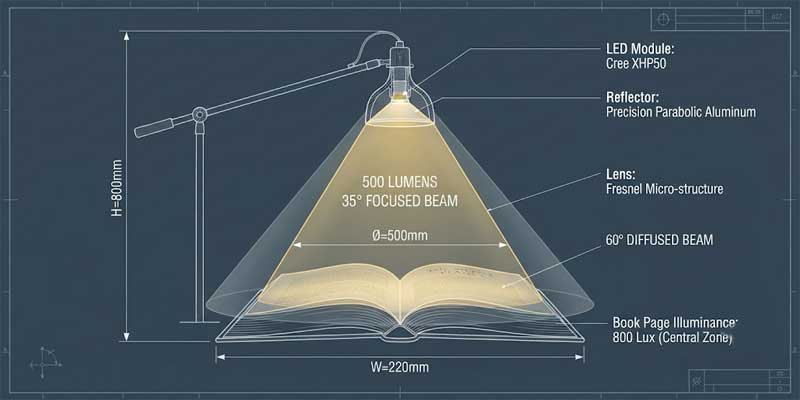
For dedicated physical book reading, aim for a focused output between 450 and 650 lumens. This output produces approximately 50 foot-candles of illuminance across your reading plane—the exact threshold recommended by the Illuminating Engineering Society (IES) for fine textual analysis. If your reading habits shift between printed ink and backlit e-readers like a Kindle Paperwhite, select an adjustable reading lamp equipped with smooth continuous dimming so you can dial output down to 250 lumens when viewing digital screens.
| Reading Medium | Recommended Lumens | Optimal Color Temperature | Optical Beam Spread |
|---|---|---|---|
| Physical Hardcovers & Paperbacks | 450 – 650 lm | 2700K – 3000K (Warm White) | 35° – 45° Concentrated Cone |
| High-Gloss Magazines & Textbooks | 400 – 500 lm | 3000K – 3500K (Soft White) | 60° Diffused Flood Lens |
| Backlit E-Readers & Tablets | 200 – 300 lm | 2700K (Warm Amber) | Soft Perimeter Wash |
Color Temperature: 2700K Warmth vs 4000K Focus
Color temperature alters how alert or relaxed your central nervous system feels during reading. Cool daylight spectrums (4000K to 5000K) enhance visual acuity and make microscopic text look razor-sharp, making them effective for daytime legal or architectural study. However, using cool light late in the evening suppresses melatonin secretion, disrupting sleep architecture.
For bedtime book lovers, pair your reading lamp with a warm 2700K to 3000K spectrum. Warm white light mimics the comforting glow of incandescent filaments and burning embers, softening the contrast between printed text and off-white book paper while encouraging natural circadian wind-down. Ensure the light source delivers a Color Rendering Index (CRI) rating of 90 or higher. High-CRI emitters prevent ink washed-out effects and maintain natural visual depth across illustrated editions.
Ergonomic Positioning: The Over-the-Shoulder Rule
Where you place your reading fixture dictates whether light illuminates your pages or gets swallowed by unwanted shadows. The most effective arrangement is the over-the-shoulder configuration, which eliminates bodily obstructions completely.
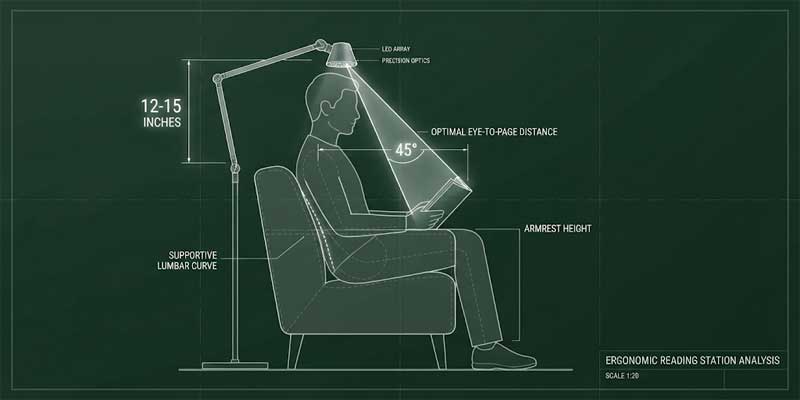
Position your reading lamp behind and slightly to the side of your primary seating position. If you are sitting in an armchair or reading propped up in bed, elevate the light head so the lower edge of the shade sits approximately 12 to 15 inches above your shoulder level and roughly 15 to 20 inches behind your head. Aim the downward beam at a 45-degree angle across your lap. Because the beam originates from behind your field of view, your head and arms cast zero shadows over the book, and the direct light diode remains completely invisible to your eyes.
For readers who share a master bed, directional focus is especially crucial. A wide-dispersion lamp floods the entire room, waking a sleeping partner. Opt for an articulated reading lamp with a narrow, deep conical shade that concentrates the light cone strictly over your side of the mattress, leaving the opposite pillow draped in restful darkness.
Choosing the Right Fixture Silhouette for Your Reading Zone
Different reading corners call for distinct mechanical configurations. Aligning the physical fixture with your spatial constraints ensures seamless daily operation:
- Adjustable Articulated Arm Lamps: Counterbalanced cantilever arms allow you to position the light head within inches of physical text and tuck it away neatly when finished.
- Slender Gooseneck Wall Sconces: Mounted directly to headboards or flanking wall studs, gooseneck designs free up table surfaces completely, making them ideal for compact sleeping spaces.
- Floor-Standing Pharmacy Luminaires: Featuring a weighted base and a low-slung, pivoting metal shade, a standing fixture tucks beside deep reading armchairs without requiring nearby side tables.
When outfitting larger reading lounges or private home libraries, balance your direct task light by pairing it with an accent Table Lamp positioned on an opposing console to maintain gentle background illumination.
Common Setup Errors That Deteriorate Reading Vision
Ensure your reading sanctuary delivers long-term comfort by guarding against these frequent layout oversights:
- Reading Under Task Light Alone in a Blackout Room: Operating an intense reading beam in pitch darkness creates a sensory trap known as contrast glare. Every time you glance away from your book, your eyes must violently adjust between brilliant white paper and black room surroundings. Always maintain subtle, layered ambient light across the room using dimmable perimeter fixtures like our dedicated Bedroom Table Lamps.
- Positioning the Light in Front of Your Face: Placing a fixture directly in front of your reading chair bounces glare backward into your eyes. Always keep the beam angled from the rear or side quadrant.
- Ignoring Pulse-Width Modulation (PWM) Flicker: Cheap LED fixtures often dim using low-frequency pulsing drivers. Even when flicker is imperceptible to the conscious eye, it causes optic nerve fatigue and headaches during reading sessions lasting over thirty minutes. Insist on flicker-free continuous-current drivers.
Elevate Your Literary Comfort with Purposeful Illumination
A well-chosen reading lamp does far more than cast light on paper; it protects your vision, elevates nighttime relaxation, and honors your love of literature. By demanding high-CRI optics, keeping color temperatures warm and soothing, calibrating output to 500 lumens, and adopting the ergonomic over-the-shoulder angle, you create a restful sanctuary where you can read in pure comfort for hours.
Take a critical look at your favorite reading chair tonight. Check whether shadows obscure your book, notice if glare reflects off the pages, and evaluate your post-reading eye strain. With simple spatial adjustments and an engineered task light, you can enjoy crisp, effortless reading every single evening.
