
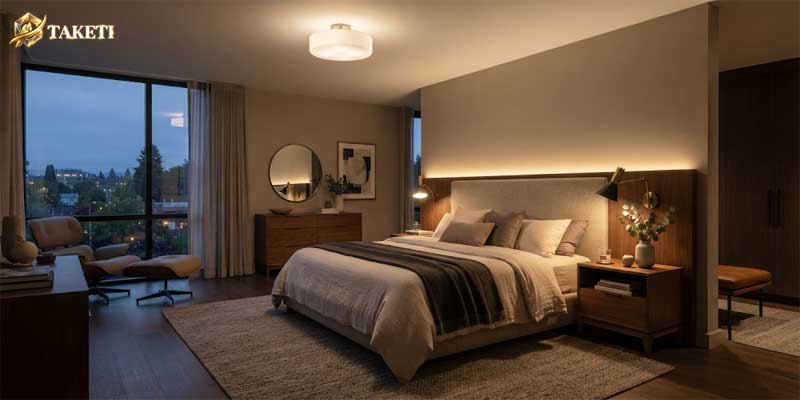
Stepping into a bedroom at the end of an exhausting day should trigger an immediate neurochemical shift toward rest. Yet, in most American residences, nighttime routines unfold beneath blinding 5000K recessed downlights or mismatched table lamps that cast invasive glare across resting retinas. True luxury in residential architecture is rarely about extravagant crystal fixtures; it centers on optical discipline. Exploring functional, scientifically calibrated bedroom lighting ideas allows you to orchestrate an environment where biological wind-down happens instinctively.
Every bedroom serves dual masters: crisp functional visibility during morning dressing routines and subdued, circadian-aligned warmth when preparing for sleep. Achieving this balance requires abandoning the obsolete habit of illuminating a room from a single center point. By pairing strategic architectural illumination with refined Bedroom Table Lamps and dedicated accent points, you transform flat drywall into a layered sanctuary characterized by visual depth and physical serenity.
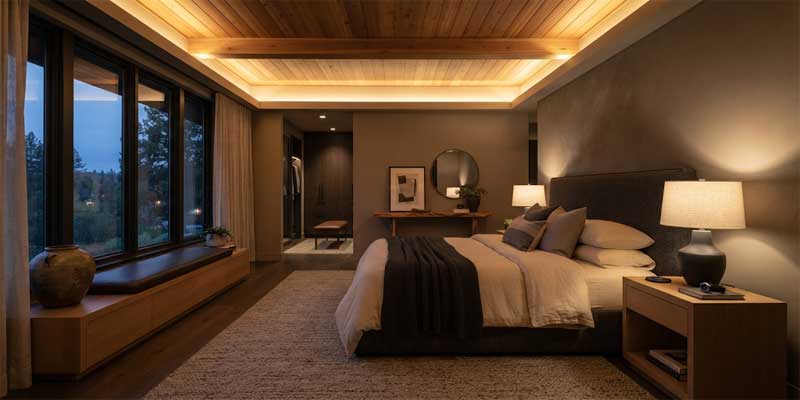
The Physics of Sleep-Centric Bedroom Lighting Ideas
Before selecting decorative brass finishes or ceramic lamp bases, we must evaluate how photic energy interacts with human physiology. The eye contains intrinsically photosensitive retinal ganglion cells (ipRGCs). These specialized neurons synthesize melanopsin, a photopigment tuned specifically to blue-cyan light wavelengths between 460 and 490 nanometers. When high-Kelvin, blue-rich light strikes these receptors past 8:00 PM, the brain halts melatonin secretion, elevating core body temperature and delaying the onset of restorative REM sleep.
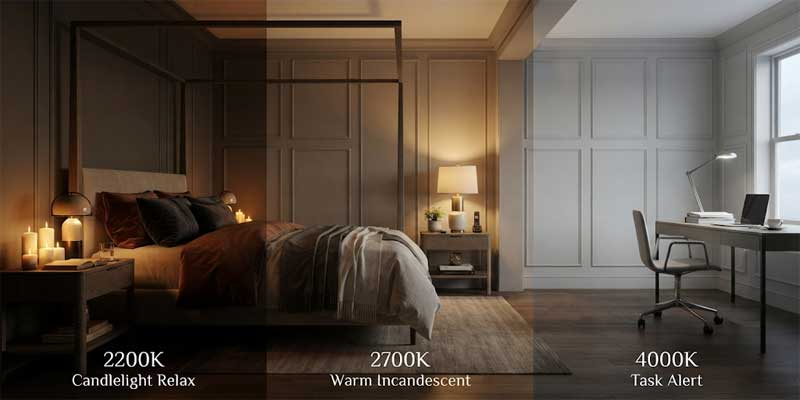
Therefore, executing high-performance bedroom lighting ideas demands strict chromatic zoning:
- Daytime Dressing & Chores (3000K, CRI 90+): Neutral white that renders clothing dyes, skin tones, and cosmetics with absolute photorealistic accuracy.
- Evening Transition (2400K – 2700K): The warm incandescent threshold. Blue spectrum emissions drop dramatically, simulating sunset wavelengths that invite muscular and ocular relaxation.
- Pre-Sleep & Midnight Navigation (1800K – 2200K or Amber-Red Wavelengths): Low-intensity illuminance registering under 20 lumens. This spectrum carries virtually zero biological stimulation, allowing uninterrupted sleep cycles even if you wake for water.
The Three Fundamental Lighting Layers Explained
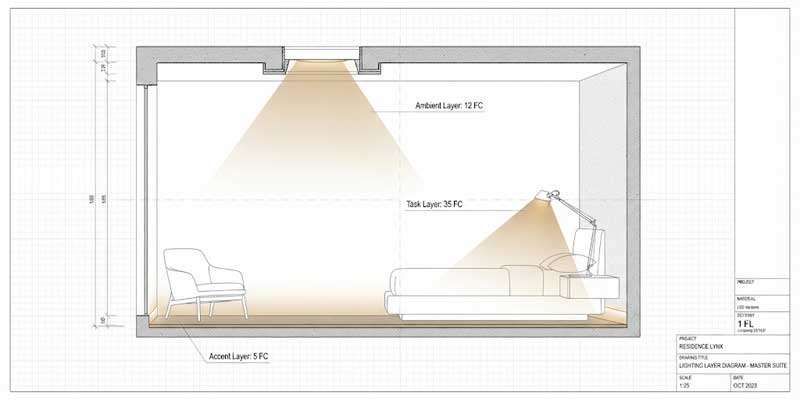
A poorly planned bedroom relies on raw intensity; a masterfully designed bedroom relies on optical contrast and balanced distribution. Professional lighting designers engineer rooms across three synchronized layers:
1. Ambient Layer (General Environmental Wash)
Ambient illumination provides safe navigation without calling attention to the hardware source. Rather than flooding the bed with downwards-beaming recessed spotlights—a layout mistake that blinds you the instant you recline—ambient light should bounce indirectly off matte ceilings or vertical perimeter walls. Semi-flush drum fixtures with frosted bottom diffusers, architectural perimeter coves, or soft uplighting floor bowls establish broad, glare-free baseline illumination.
2. Task Layer (Direct Functional Target)
Task illumination delivers focused, high-contrast foot-candles to pinpoint activities without spilling unwanted lumens across a sleeping partner. Bedside reading represents the primary task in any bedroom. A well-shielded luminaire positioned at the correct angle projects light directly onto the printed page or tablet while leaving the adjacent half of the mattress in peaceful shadow. Additional task zones include vanity desks, walk-in closet dressing islands, and dedicated reading armchairs.
3. Accent Layer (Atmospheric Depth & Architectural Interest)
Accent illumination provides emotional warmth. It softens high-contrast shadows created by task lights and prevents a dark bedroom from feeling like a cave. Integrating discreet low-voltage LED Lights within drapery pockets, under floating nightstand bases, or grazing along a textured wooden slat wall adds three-dimensional sculpture to architectural surfaces.
| Layer Category | Recommended Hardware | Target Illuminance (Foot-Candles) | Circadian Color Temp (Kelvin) |
|---|---|---|---|
| Ambient | Diffused flush mounts, ceiling coves, linear wall grazing | 10 – 15 FC | 2400K – 2700K |
| Bedside Task | Opaque/linen-shaded lamps, directional pinhole sconces | 30 – 40 FC | 2400K – 2700K |
| Closet / Vanity Task | Flanking vertical linear fixtures, high-CRI recessed spots | 40 – 60 FC | 3000K (CRI 95+) |
| Accent | Under-cabinet tape light, art frame projectors, plinth glow | 3 – 8 FC | 2200K – 2400K |
Precision Mathematics: Calculating Lumens and Fixture Proportions
One of the most frequent structural oversights in home decoration is purchasing fixtures by aesthetic appearance rather than mathematical scale. An oversized chandelier overwhelms modest ceiling clearance, while an undersized bedside lamp forces you to strain while reading.
Calculating Total Bedroom Lumens
To calculate baseline ambient requirements for your bedroom, multiply room square footage by target foot-candles (1 foot-candle = 1 lumen per square foot). For restful bedrooms, a general ambient density of 10 to 15 lumens per square foot is ideal.
- Formula: Room Length (ft) × Room Width (ft) × 12 (Target Lumens/Sq Ft) = Total Ambient Lumens
- Worked Example: A typical 14 × 16 foot primary bedroom comprises 224 square feet. Multiplying 224 by 12 yields roughly 2,688 total ambient lumens. Rather than deploying one blinding 2,700-lumen fixture, divide this aggregate across one soft 1,200-lumen semi-flush ceiling fixture and two 700-lumen perimeter fixtures or lamps.
The Nightstand and Lamp Proportion Equation
Achieving visual harmony requires disciplined scale. When shopping for a bedside Table Lamp, follow standard architectural scale formulas:
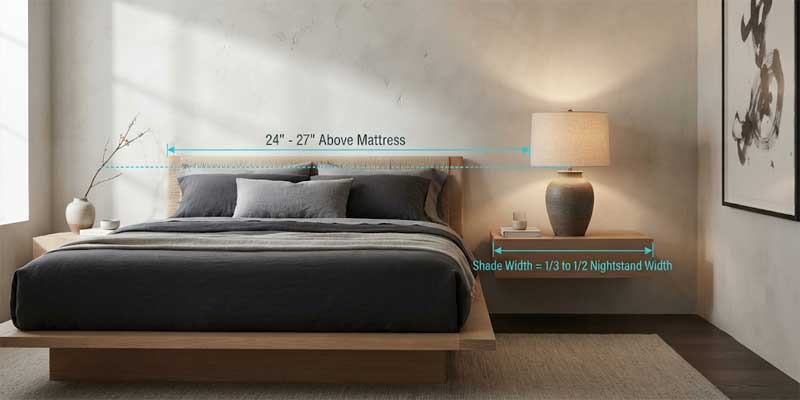
- The One-Third to One-Half Width Rule: The maximum diameter of your lampshade must never exceed 50% of the total width of your nightstand. A 24-inch wide nightstand requires a lampshade with a maximum diameter between 10 and 12 inches, preserving tabletop area for books, water carafes, and devices.
- The Eye-Level Shade Baseline: Sit completely upright in bed against your headboard in your normal nighttime reading posture. Have someone measure the vertical height from the floor to your eye level (or chin level). The bottom rim of your lampshade should align exactly with this measurement (typically 24 to 27 inches above the top surface of your mattress). This physical geometry ensures the incandescent bulb remains hidden behind the shade rim, casting focused light downwards onto your lap without exposing the bare filament to your direct vision.
9 Creative Bedroom Lighting Ideas Tailored for Distinct Layouts
Implementing effective illumination demands creative adjustments based on architectural floor plans. Here are 9 design schemes engineered for real-world residential challenges:
1. Asymmetrical Wall Sconce and Table Lamp Pairings
Modern luxury design has moved past hyper-symmetrical hotel setups where identical lamps sit on identical tables. Consider pairing an elegant ceramic table lamp on one side of the bed with a wall-mounted articulating brass sconce on the other. This configuration adds dynamic tension and adapts effortlessly if one partner reads extensively while the other prefers ambient relaxation.
2. Concealed Floating Nightstand Underglow
Mounting floating nightstands clears valuable floor space in small bedrooms. Run a low-wattage, warm 2200K flexible LED strip inside a 45-degree aluminum diffusion channel along the underside rear lip of the nightstand. Connected to an inconspicuous bedside rocker switch or passive motion sensor, this provides subtle floor-level illumination for midnight navigation without disrupting nocturnal biological rhythms.
3. Recessed Wall Grazing Behind Upholstered Headboards
Instead of mounting art above the bed, construct a shallow drywall recess or install vertical oak wood slats behind an upholstered velvet headboard. Tucking indirect warm LED extrusions behind the headboard perimeter creates a luminous halo effect, converting the entire bed wall into a tranquil focal element.
4. Dropped Bedside Mini-Pendants
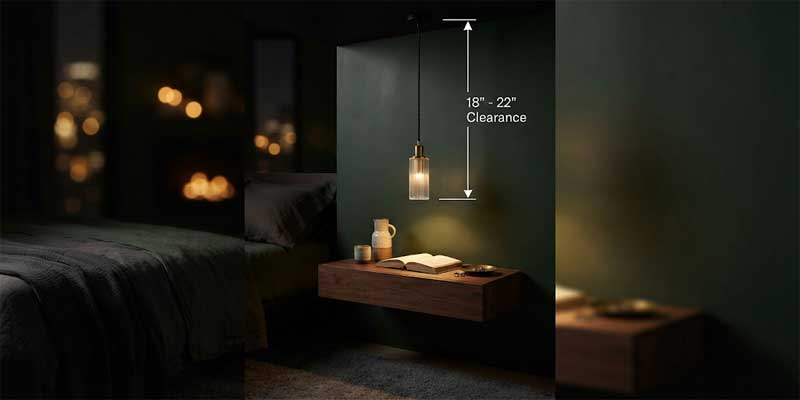
In narrow urban bedrooms where nightstands measure under 16 inches wide, table lamps consume critical utility space. Suspending slender, architectural mini-pendants from the ceiling directly over nightstands reclaims 100% of tabletop surfaces. Ensure pendants hang roughly 18 to 22 inches above the nightstand top and feature solid metal, spun brass, or opaque ceramic shades that focus light strictly downward.
5. Wardrobe Perimeter Lighting and High-CRI Spotting
Avoid placing ambient ceiling fixtures directly in the physical center of the bedroom ceiling, which typically casts your shadow across open closet doors. Instead, position recessed pinhole fixtures 24 to 30 inches off the face of closet cabinets. Utilize bulbs with a Color Rendering Index (CRI) of 95 or higher to differentiate between deep navy and black garments easily in early morning light.
6. The Architectural Ceiling Cove Wash
If you have high tray ceilings or are undertaking a structural renovation, construct an indirect perimeter cove. Mounting warm 2400K LED ribbons within the cove directs illumination upward against a white ceiling plane. The entire ceiling becomes a massive, low-luminance light bounce, illuminating the room without a single visible bulb or point-source glare.
7. Cozy Reading Corner Floor Fixtures
Position an oversized, textured armchair in an unoccupied corner paired with a slender, arched pharmacy-style floor lamp. Pharmacy lamps feature adjustable swivel heads and physical shields, keeping directional task beams isolated to reading material. This builds a secondary sanctuary away from the bed for quiet late-evening unwinding.
8. Hidden Baseboard Linear Guide Lighting
For primary suites with ensuite baths, navigation during the night can disrupt sleep if vanity overheads are switched on. Install continuous low-voltage linear micro-extrusions under baseboards or along the hallway corridor. Emitting an ultra-dim, non-stimulating amber glow, these guidepaths provide clear footing while preserving full night vision.
9. Multi-Zone Digital Dimming and Dual-Switch Control
Hardware quality is meaningless without circuit control. Divide your bedroom lighting across a minimum of three independent lighting circuits: 1) Ambient ceiling wash, 2) Left and right bedside task lights (individually switched), and 3) Accent LED washes. Always specify 3-way switches: one master control switch at the entryway door and companion switches directly beside the headboard, guaranteeing that turning off lights never requires leaving a warm bed.
Diagnostic Troubleshooting: Avoiding Common Bedroom Lighting Pitfalls
Before finalizing your fixture selections, audit your space against these recurring architectural errors:
- The Direct-Overhead Glare Trap: Installing recessed cans directly in line with where your head rests on the bed is the single most common design mistake. Angle downlights toward accent walls or push them completely out of the bed zone.
- The Translucent Shade Error: Thin, synthetic paper shades transmit light sideways directly into your peripheral field of view, creating visual fatigue. Select dense linen, pleated silk, or heavy cardstock shades that direct light cleanly up and down.
- Bulb Mismatch Syndrome: Mixing a 2700K bedside bulb with a 4000K overhead flush mount creates jarring visual discordance. Standardize all resting area bulbs within the 2400K to 2700K range to keep your visual landscape harmonious.
- Ignoring Dimmer Compatibility: Incompatible LED bulbs and legacy incandescent rotary dimmers cause high-pitch buzzing and rhythmic light flickering. Verify that your LED lamps use forward-phase or reverse-phase digital ELV (Electronic Low Voltage) dimmers rated explicitly by the lamp manufacturer.
Frequently Asked Questions About Bedroom Lighting Ideas
What is the ideal wattage equivalent for bedroom table lamps?
For modern LED installations, target bulbs consuming 5 to 8 Watts, which produce 450 to 600 lumens of light. This output matches traditional 40W to 60W incandescent output, delivering comfortable task lighting for book reading without overwhelming a darkened room.
Should bedroom ceiling fixtures match the finish of bedside lamps?
Not necessarily. Exact catalog matching can make a bedroom feel rigid and uninspired. Interior designers prefer complementary metal finishes. For instance, pairing a matte black architectural ceiling pendant with unlacquered aged brass bedside sconces adds curated character, provided fixture undertones and bulb color temperatures remain consistent.
How do I light a small bedroom without nightstands?
When floor and surface footprints are restricted, move all fixtures off the horizontal plane. Wall-mounted articulating swing-arm sconces hardwired beside the headboard or sleek pendant lights suspended from ceiling junction boxes provide functional reading light while keeping floor and table areas clear.
Is cool white light ever acceptable in a master bedroom?
Cool white light (3500K to 4000K) should be restricted entirely to enclosed closets, dressing mirror backlights, and private en-suite bathroom vanities where accurate grooming, makeup application, and outfit matching demand neutral daytime color representation. In open sleeping areas, cool white light should be avoided.
