
Selecting functional nightstand lamps requires balancing ergonomic task lighting with proportional bedroom furniture scales. Homeowners frequently purchase fixtures based purely on visual appeal, only to discover oversized shades that crowd bedside surfaces or exposed bulbs that cause harsh glare while reading in bed. By applying rigorous architectural guidelines to base height, tabletop ratios, shade geometry, and photometric output, you can deploy nightstand lamps that integrate effortlessly into your master suite while preserving your natural evening sleep cycle.
Proportion and Scale: Sizing Nightstand Lamps to Your Bedside Table
The visual balance of a master bedroom hinges on the dimensional relationship between the luminaire and the tabletop surface. A widespread interior design mistake is placing diminutive accent lights beside expansive king mattresses, or conversely, installing hulking ceramic fixtures that monopolize compact urban nightstands. When spatial proportions are ignored, the bedroom loses architectural cohesion, leaving nightstands cluttered and visually unstable.
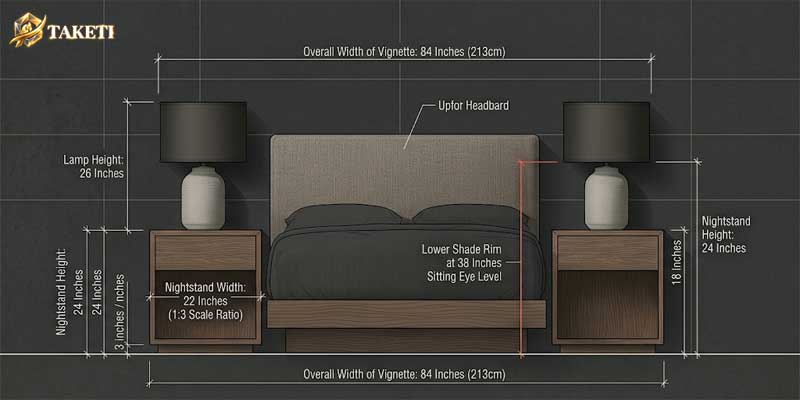
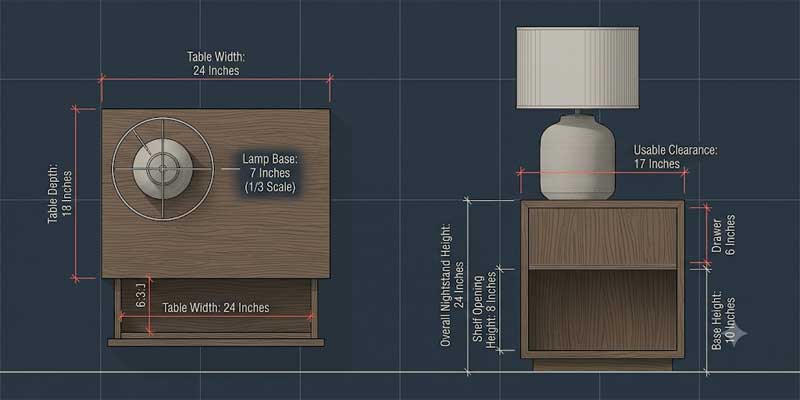
As a baseline standard, the base footprint and maximum shade diameter of your nightstand lamps should occupy approximately one-third of the usable tabletop width. This leaves two-thirds of the perimeter completely free for books, water carafes, eyeglasses, and charging trays. For instance, on a standard 24-inch wide nightstand, the widest section of your fixture should not exceed 8 to 9 inches.
Furthermore, headboard height serves as a vertical benchmark. Well-proportioned nightstand lamps should align harmoniously with the upper profile of the headboard without towering awkwardly above it or disappearing below mattress sightlines. Coordinating balanced fixtures from our collection of bedroom table lamps ensures your sleeping sanctuary maintains unified horizontal sightlines and structural symmetry across both sides of the bed.
| Bed & Table Setup | Average Table Width | Table Depth | Ideal Lamp Base Diameter | Recommended Shade Width |
|---|---|---|---|---|
| Twin Bed / Compact Stand | 16 – 18 Inches | 14 – 16 Inches | 4 – 5 Inches | 8 – 10 Inches |
| Full Bed / Standard Stand | 18 – 22 Inches | 16 – 18 Inches | 5 – 7 Inches | 10 – 12 Inches |
| Queen Bed / Medium Stand | 22 – 26 Inches | 18 – 20 Inches | 6 – 8 Inches | 12 – 14 Inches |
| King Bed / Wide Nightstand | 28 – 34 Inches | 20 – 24 Inches | 8 – 11 Inches | 15 – 18 Inches |
| Floating Shelf / Minimalist Nook | 12 – 14 Inches | 10 – 12 Inches | 3 – 4 Inches (Slim) | 6 – 8 Inches |
Rule 1: Coordinate Nightstand Lamps Height with the 60-Inch Eye Line Benchmark
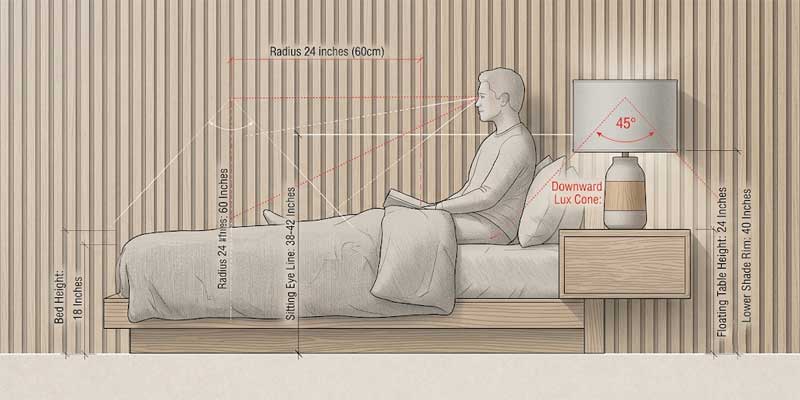
Bedside task illumination fails if the raw bulb filament shines directly into your pupils while you read or recline. The universal ergonomic benchmark dictates that the lower rim of the shade on your nightstand lamps must sit level with your eye height when seated upright against your pillows. In standard residential architecture, a seated reader’s eye level rests between 38 and 42 inches above the finished floor.
To calculate your target fixture height, measure the vertical distance from the top of your nightstand surface to the finished floor. Subtract that table elevation from the 60-inch total vertical eye-line target. If your nightstand stands 24 inches high, target nightstand lamps that measure between 26 and 28 inches tall from the weighted plinth to the finial tip.
If your mattress sits unusually high due to a deep pillow-top or box spring, standard table lamps will cast harsh upward beams across your eyes. Always measure from your actual compressed mattress surface when calculating these clearances. Elevating or lowering the table height ensures that the opaque shade edge acts as a natural mechanical barrier against unshielded bulb glare.
Rule 2: Balance Shade Proportions and Diffuser Geometry
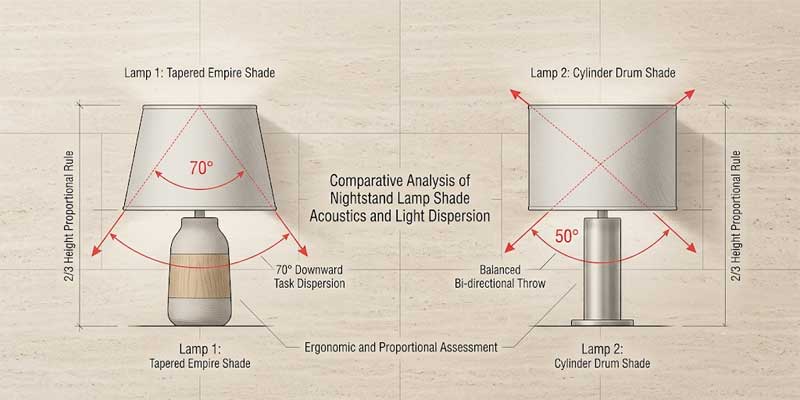
A lampshade does far more than diffuse light; it establishes the silhouette and scale of the entire luminaire. When evaluating nightstand lamps, verify that the shade height equals roughly two-thirds of the lamp base height, measured from the bottom of the plinth to the base of the socket. The bottom diameter of the shade should be equal to or within two inches of the base’s total vertical height.
For optimal nighttime comfort, specify cylindrical drum or gentle empire shades constructed from textured linen, parchment, or handmade cotton paper. Avoid narrow conical shades that restrict downward beam spreads, and always ensure your nightstand lamps conceal the socket assembly and harp hardware when viewed from a standard standing or seated approach.
| Shade Profile | Light Dispersion Angle | Glare Protection Rating | Photometric Distribution | Best Bedside Application |
|---|---|---|---|---|
| Classic Cylinder Drum | 50° Top / 50° Bottom | Superior (Conceals hardware) | Balanced upward ambient and downward task | Dedicated nightstand task reading |
| Tapered Empire | 30° Top / 70° Bottom | High (Directs lux downward) | Focused downward reading beam | Narrow nightstands and compact suites |
| Square / Rectangular | Bi-directional Side Throw | Moderate (Requires flush wall placement) | Lateral grazing on wall surface | Modern shallow console tables |
| Exposed Globe / Glass | 360° Omnidirectional | Low (High risk of optic fatigue) | Unfiltered ambient glow | Pure decorative mood lighting |
Rule 3: Optimize Nightstand Lamps with Warm 2700K Dimmable Illumination
Blue-rich daylight temperatures are destructive to nocturnal circadian biology. When equipping nightstand lamps, avoid crisp 4000K or 5000K cool bulbs that inhibit natural melatonin secretion and delay sleep readiness. The target color temperature for bedside living spaces remains consistently between 2200K (ultra-warm candle-like tone) and 2700K (soft residential white).
Deploy specialized low-wattage LED lights delivering between 300 and 450 lumens for evening reading sessions. Integrating step-dimming or inline rotary rheostats allows users to lower output down to 10–30 lumens for midnight transitions without disturbing their sleeping partner. A dedicated high-CRI (Color Rendering Index > 90) bulb ensures that printed text and surrounding fabric textures appear crisp and vivid without washing out under artificial light.
Rule 4: Evaluate Base Ballast, Weight Distribution, and Switch Placement
Ergonomics extends beyond light quality to physical interaction. Because users routinely interact with nightstand lamps in semi-conscious or darkened states, physical stability is paramount. Lightweight acrylic or thin hollow-metal lamps tip over easily when reaching for glasses, alarm clocks, or water cups during the night.
Select heavy, weighted bases manufactured from solid ceramic, turned hardwoods, cast bronze, or natural stone like travertine and marble. The center of gravity should sit low in the base structure. Furthermore, evaluate the switch mechanism carefully:
- Inline Cord Switches: Often slip behind tables, forcing users to reach into narrow gaps between the wall and nightstand.
- Socket Turn Knobs: Reliable, but can cause fingertip burns if placed too close to hot halogen or incandescent bulbs.
- Touch-Sensors and Base Rockers: The gold standard for modern nightstand lamps, allowing effortless operation with a single tap in total darkness.
Rule 5: Maintain Cohesive Styling Across Living and Sleeping Zones
While symmetrical pairs of matching nightstand lamps remain a timeless staple in master bedroom design, modern interior schemes frequently incorporate calculated asymmetry. Homeowners can mix distinct silhouettes across dual bedside stations provided the finish, visual weight, or color palettes share a coherent design language.
Ensure your bedside lighting ties seamlessly into your overarching residential lighting scheme. Pairing ceramic or textured brass bases with complementary designs found across your living area’s table lamp arrangements creates architectural continuity throughout the entire home, establishing a polished aesthetic from entry foyer to private retreat.
Photometric and Clearance Calculations for Bedside Suites
To ensure absolute precision during installation, professional lighting designers rely on specific mathematical ratios. Use this reference breakdown when mapping out your fixture clearances:
- Clearance from Finished Wall: Maintain a minimum clearance of 2 to 3 inches between the outer edge of your lampshade and the wall. This protects delicate shade fabrics from friction abrasions and provides adequate room for hand access to wall outlets.
- Mattress-to-Table Elevation Ratio: The ideal bedside table sits within 2 inches of the top of your mattress (either 2 inches higher or 2 inches lower). If your nightstand deviates significantly from this range, adjust your nightstand lamps base height accordingly to preserve the 38-to-42-inch seated eye line.
- Lux Levels on Book Surfaces: For sustained nighttime reading without visual fatigue, aim for 20 to 30 foot-candles (approximately 200 to 300 lux) directed specifically across your book or reading tablet.
Common Nightstand Lighting Mistakes and Solutions
Subtle execution errors can diminish the aesthetic value and everyday utility of your bedside lighting. Avoid these prevalent installation traps:
- Placing Fixtures Too Far Out of Arm’s Reach: Ensure switch mechanisms on your nightstand lamps can be reached easily without leaning forward or shifting awkwardly from a resting position.
- Selecting Bases with Insufficient Ballast: Lightweight aluminum or fragile unweighted acrylic bases tip over when reaching for alarm clocks. Prioritize substantial ceramic, cast brass, or stone bases that anchor firmly to the tabletop.
- Exposing Raw Bulbs Below the Shade Trim: If the harp hardware is too tall, the incandescent or LED socket will peek out from beneath the rim, creating uncomfortable glare spots. Always adjust your harp height so the shade sits 0.5 inches below the socket base.
- Overloading Tabletop Surfaces: Selecting a shade diameter larger than the table’s depth causes the shade to overhang the edge, increasing the risk of accidental knockdowns when navigating the room in the dark.
Frequently Asked Questions About Bedside Table Lighting
Should nightstand lamps match each other exactly?
In traditional and transitional interior decorating, matching pairs of nightstand lamps deliver calming visual symmetry on either side of the bed. However, modern and eclectic aesthetics frequently pair mismatched fixtures—such as a sculpted table lamp on one side and an architectural wall sconce or pendant on the other—provided both light sources align at identical sightline elevations and share similar color temperatures.
What is the ideal wattage equivalent for nightstand lamps?
Modern LED bulbs for bedside reading should draw between 4 and 6 watts, which provides an incandescent equivalent of approximately 40 watts (350 to 450 lumens). This luminous intensity provides crisp page clarity without causing optical fatigue before sleep.
How far from the wall should nightstand lamps sit?
Position your nightstand lamps with a minimum of two to three inches of clearance between the outer rim of the lampshade and the finished wall surface. This spacing prevents fabric abrasions, allows heat dissipation, and facilitates easy access to inline cord switches.
Can you use smart tunable bulbs in nightstand lamps?
Yes. Equipping nightstand lamps with tunable smart LED bulbs is an exceptional strategy for circadian support. It allows you to program crisp 3000K neutral light for early evening dressing and reading, which automatically shifts to ultra-warm 2200K amber or pure monochromatic red tones 60 minutes prior to bedtime.
