
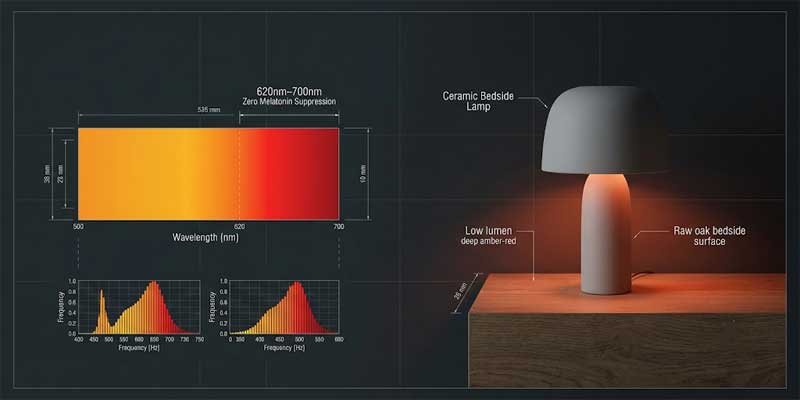
Modern residential bedrooms are inundated with synthetic illumination that directly conflicts with human biology, making red light for sleep an indispensable protocol for restorative rest. Standard overhead fixtures and digital displays flood nighttime environments with short-wavelength blue light, sending erroneous daylight signals directly to the suprachiasmatic nucleus in the brain. By transitioning to long-wavelength red lighting in the evening, homeowners can illuminate their living quarters while preserving natural melatonin synthesis, accelerating sleep onset, and stabilizing the circadian cycle.
How Red Light for Sleep Protects Your Natural Melatonin Production
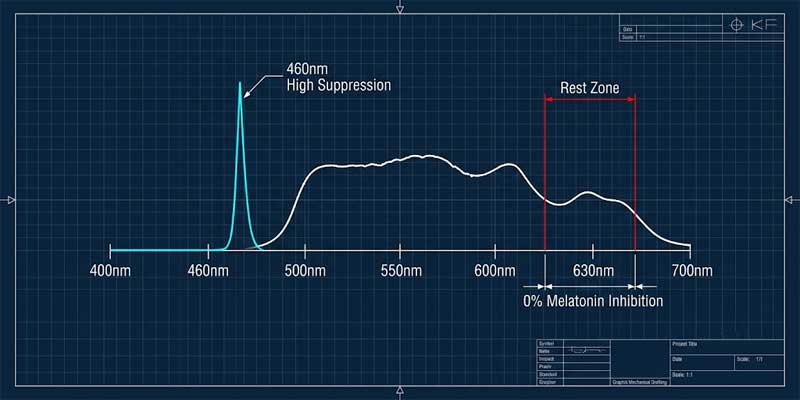
The human eye detects ambient illumination through specialized photoreceptor cells known as intrinsically photosensitive retinal ganglion cells (ipRGCs). These cells contain melanopsin, a photopigment uniquely sensitive to blue and green wavelengths spanning 450 to 490 nanometers. When blue spectrum light strikes these receptors, it triggers neural firing that immediately suppresses melatonin secretion from the pineal gland, maintaining elevated alertness and delaying REM latency.
Conversely, utilizing red light for sleep leverages long-wavelength illumination between 620 and 750 nanometers, which completely fails to stimulate melanopsin photopigments. Red spectrum light passes through the visual system without prompting the biological cascade that halts melatonin release. Incorporating targeted low-Kelvin solutions such as specialized LED lights engineered for circadian protection enables functional indoor visibility during evening hours while signaling to the endocrine system that night has arrived.
| Light Spectrum | Wavelength (nm) | Melanopsin Sensitivity | Impact on Melatonin | Optimal Time of Exposure |
|---|---|---|---|---|
| Blue / Cool White | 450 – 485 | Maximum (95–100%) | Severe suppression (delays sleep) | Morning & Midday only |
| Daylight Neutral | 500 – 550 | Moderate to High (60–80%) | Substantial suppression | Afternoon work sessions |
| Warm White (2700K) | 580 – 610 | Low to Moderate (25–35%) | Mild suppression at high lux | Early evening transition |
| Deep Red / Amber | 620 – 700+ | Negligible (0–2%) | Zero suppression (protects sleep) | 1–2 hours prior to sleep |
Rule 1: Calibrate Your Red Light for Sleep Within the 630nm to 670nm Zone
Not all colored bulbs achieve true circadian preservation. Many inexpensive RGB party bulbs emit fragmented spectral spikes that contain residual green and yellow wavelengths capable of triggering ipRGC responses. Authentic red light for sleep fixtures must utilize narrow-band diodes calibrated specifically within the 630 to 670 nanometer window.
This narrow frequency delivers pure monochromatic red or deep amber illumination. Within this exact range, red light for sleep mimics the low-angle, scattering frequencies of a twilight horizon or ancestral campfire, offering sufficient lumen density for safe movement while keeping retinal sensitivity completely inert.
Rule 2: Restrict Luminous Flux Below 50 Lumens
Wavelength is merely one half of the circadian equation; light intensity represents the second critical vector. Exposing the eyes to an intensely bright 500-lumen red fixture will stimulate standard rod and cone photoreceptors, causing visual strain and physiological wakefulness regardless of color temperature. Therefore, deploying red light for sleep requires strict regulation over luminous flux.
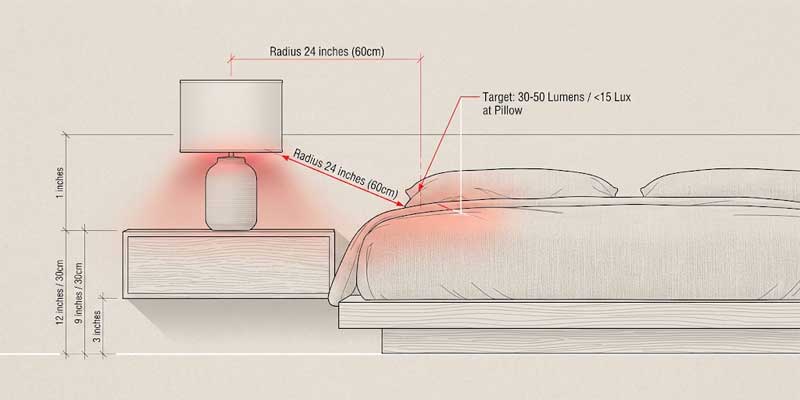
For dedicated evening routines, bedroom task fixtures and reading spots should deliver no more than 30 to 50 lumens of net output. For nighttime navigation, ambient orientation fixtures must remain below 10 lumens. This subdued illumination level prevents pupillary constriction and ensures that red light for sleep keeps the sympathetic nervous system in an undisturbed parasympathetic state.
| Application Zone | Recommended Lumens | Mounting Location | Primary Functional Objective |
|---|---|---|---|
| Nightstand Reading | 30 – 50 Lumens | Eye-level table base or sconce | Book page visibility without eye strain |
| Architectural Accent | 20 – 40 Lumens | Under-bed or baseboard perimeter | Soft spatial perimeter definition |
| Path Navigation | 5 – 10 Lumens | Plugged low at electrical receptacle | Disorientation prevention during midnight waking |
Rule 3: Maintain Low-Angle Fixture Positioning Below Eye Level
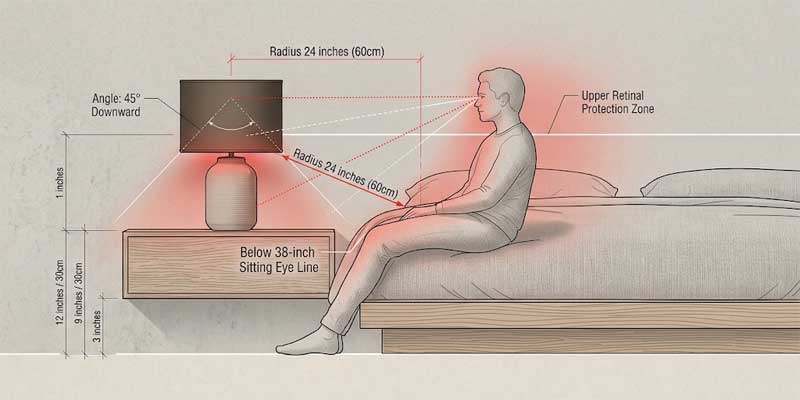
The spatial distribution of light inside the room plays a profound biological role. The melanopsin-containing ipRGCs are concentrated predominantly in the inferior (lower) hemisphere of the human retina. Consequently, light entering from elevated angles—such as ceiling recessed downlights or high chandeliers—strikes these sensitive receptors with maximum efficiency, tricking the brain into perceiving midday sunlight.
To eliminate this trigger when applying red light for sleep, position evening light sources strictly below standard standing and sitting eye levels. Placing a warm or red fixture on low surfaces, such as dedicated bedroom table lamps equipped with opaque or deep drum shades, directs lumens downward onto table surfaces and floorboards, entirely bypassing the sensitive inferior retinal zone.
Rule 4: Execute the 60-Minute Pre-Sleep Lighting Sequence
Circadian realignment does not occur instantaneously at the flip of a switch. Biological sleep pressure builds gradually in response to dimming ambient lux levels. Homeowners should introduce a structured two-stage evening transition to maximize the biological benefits of red light for sleep before rest.
- Phase 1: 120 to 60 Minutes Before Bed: Extinguish all overhead fluorescent and cool-white ambient lighting. Transition the living and sleeping quarters to warm 2200K–2700K accent sources placed upon side consoles or decorative table lamp fixtures to initiate natural eye relaxation.
- Phase 2: 60 Minutes to Bedtime: Terminate all electronic display exposure and shift exclusively to narrow-band red light for sleep. Dim the total luminous output to minimum navigation levels, allowing pineal melatonin synthesis to reach peak concentration prior to head-to-pillow contact.
Common Mistakes When Deploying Nighttime Lighting
Many homeowners inadvertently compromise their sleep sanctuaries through subtle installation errors. Recognizing these widespread oversights ensures your nighttime setup yields genuine restorative benefits:
- Relying on Generic Smart RGB Bulbs at Low Brightness: Standard multi-color smart bulbs often mix red with subtle blue and green diodes to achieve brightness, leaking disruptive wavelengths into your retina. Always select dedicated single-spectrum monochromatic red bulbs when installing red light for sleep.
- Positioning Light Sources Directly in the Field of View: An unshielded filament bulb located on an open shelf casts direct glare onto the cornea. Always diffuse long-wavelength red light for sleep through fabric shades, frosted diffusers, or indirect wall bounce.
- Leaving Secondary Electronics Uncovered: A single blue power LED on an air purifier or television monitor can emit up to 15 lux of concentrated blue photons directly toward your pillows. Apply opaque blocking tape to all electronic indicator lights in the bedroom to complement your red light for sleep routine.
Frequently Asked Questions About Lighting and Rest
Can you leave a red light on all night while sleeping?
While sleeping in absolute pitch darkness remains the gold standard for continuous REM and deep sleep architecture, keeping a low-intensity red light for sleep (under 10 lumens) illuminated throughout the night is biologically benign. Because red wavelengths do not suppress melatonin or disrupt brainwave rhythms, it serves as the safest illumination option for children, nursing parents, or individuals prone to nighttime anxiety.
How does red light differ from amber or 2200K extra warm white?
Extra warm white (2200K to 2700K) and amber lights significantly reduce blue light emissions compared to standard 5000K daylight bulbs, making them ideal for general early-evening dining and relaxation. However, they still contain fractional yellow and green wavelengths. Pure red light for sleep (630nm–670nm) contains zero blue or green light, making it the only spectrum that guarantees absolute non-suppression of nocturnal melatonin.
Does red light therapy have the same effect as ambient red sleep light?
No. Red light therapy (photobiomodulation) utilizes ultra-high-powered LEDs and lasers emitting thousands of lumens at focused 660nm and 850nm near-infrared wavelengths to stimulate cellular ATP production in skin and muscle tissues. Ambient red light for sleep utilizes extremely low-lumen, diffused output designed purely for gentle optical navigation without endocrine disruption.
