
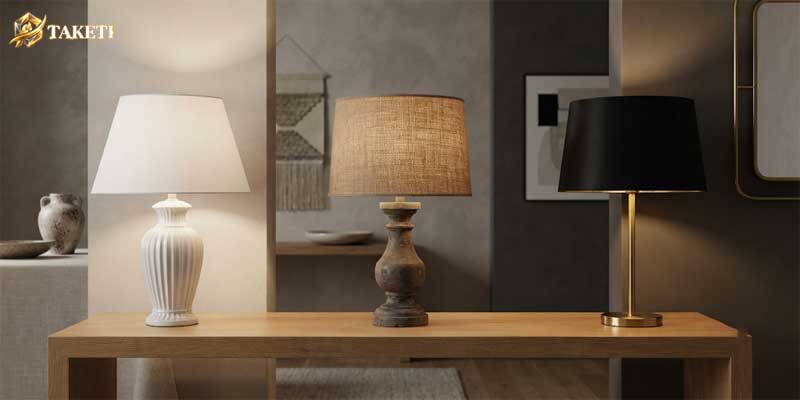
Few interior upgrades deliver the dramatic transformation of swapping out tired, discolored, or ill-fitting lamp shades. While a durable ceramic or brass base can easily last generations, fabric and paper coverings degrade under years of airborne dust, UV exposure, and incandescent heat. Replacing your worn covers with tailored lamp shades is the quickest way to refresh a room’s aesthetic, yet homeowners frequently find the replacement process unexpectedly frustrating when new pieces arrive with incompatible mounting rings or out-of-scale silhouettes.
A successful replacement requires mastering both architectural proportion and mechanical hardware compatibility. Selecting the wrong fitter type guarantees an unmountable shade, while ignoring thermal clearance distances creates serious household safety hazards. Whether refreshing your bedside sanctuary with coordinated Bedroom Table Lamps or updating an heirloom floor fixture, understanding the precise engineering behind properly fitted lamp shades ensures flawless execution on your first purchase.
Deconstructing Fitter Hardware: Why Replacement Lamp Shades Fail
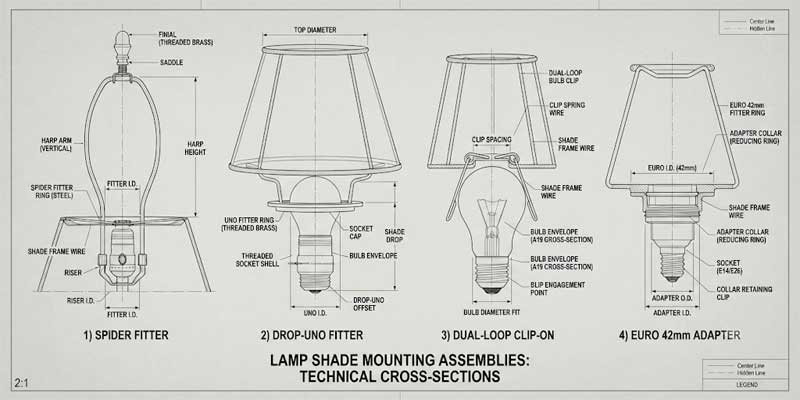
The single most frequent reason replacement lamp shades get returned to retailers is mechanical incompatibility. In the United States lighting market, shades do not mount using a universal bracket. Instead, they rely on four distinct fitter configurations that dictate how the frame anchors to the electrical socket or harp assembly:
1. Spider and Harp Assembly (Washer Fitters)
Found on roughly 75% of American table and floor lamps, a spider fitter consists of three or four metal spokes radiating inward from the top rim of the shade, converging at a central 1/2-inch brass washer ring. This washer drops directly over the threaded stud of a U-shaped vertical wire harp that straddles the bulb socket. A decorative screw-on finial then tightens down against the washer, locking the shade firmly in place. When buying spider-fitted lamp shades, remember that changing the harp height (available in 1/2-inch increments from 7 to 12 inches) allows you to raise or lower the vertical resting position of the shade on your existing base.
2. Uno Fitters (Threaded vs. Slip-On)
Uno fitters eliminate the external harp entirely, making them standard on compact accent lamps, bridge reading lights, and bedside fixtures. The spokes drop downward from the shade’s rim, terminating in a large, unthreaded 1-5/16-inch inner ring. In standard drop-uno configurations, this ring slides over the exterior of a threaded phenolic or ceramic socket shell and is held tightly against a shoulder collar by a plastic or threaded brass socket ring. The light bulb is then screwed in above the fitter ring. Attempting to force standard Uno lamp shades onto a harp-equipped base without a specialty saddle adapter is impossible.
3. Clip-On Assemblies (Torpedo vs. Standard A19)
Commonly reserved for small chandeliers, wall sconces, or diminutive boudoir lamps, clip-on fitters feature two flexible, spring-loaded wire loops extending from the frame. These loops grip directly onto the glass envelope of the bulb itself. You must match the clip geometry to the bulb shape: flame-tip candelabra clips will slip off a standard household A19 bulb, while standard teardrop bulb clips will crack or warp mini candelabra glass when securing smaller clip-on lamp shades.
4. European Euro Fitters (40mm – 43mm Ring)
Contemporary imported lighting fixtures from European and Scandinavian manufacturers commonly utilize an oversized Euro fitter ring measuring approximately 1-5/8 inches (40mm to 43mm). These sit over wide Edison screw (E26/E27) collars. Homeowners mounting Euro-style lamp shades onto standard domestic lamps will require a stamped metal adapter reduction ring to prevent lateral wobble.
| Fitter Configuration | Mounting Point | Hardware Required | Primary Fixture Application |
|---|---|---|---|
| Spider / Washer | Rests atop vertical metal harp | Harp saddle + threaded finial | Standard table lamps, floor torches, accent lamps |
| Uno Drop Ring | Clamps directly over socket shell | Threaded socket retaining ring | Small bedside lamps, swing-arm task lamps |
| Clip-On Spring | Clamps around bare glass bulb envelope | None (integral tension wire) | Sconces, multi-arm chandeliers, mini desk lamps |
| Euro Ring (E27) | Slips over large 40-43mm socket base | Adapter reducer ring (for US bases) | Contemporary Scandinavian and imported fixtures |
The Golden Ratios for Sizing Lamp Shades
Achieving visual balance between a base and its shade is governed by classic architectural ratios. Oversized lamp shades look top-heavy and threaten physical stability, while a skimpy shade leaves raw electrical socket components exposed to view. Measure your base with a rigid steel tape and apply these standard proportions:
1. The Vertical Height Formula (Two-Thirds Rule)
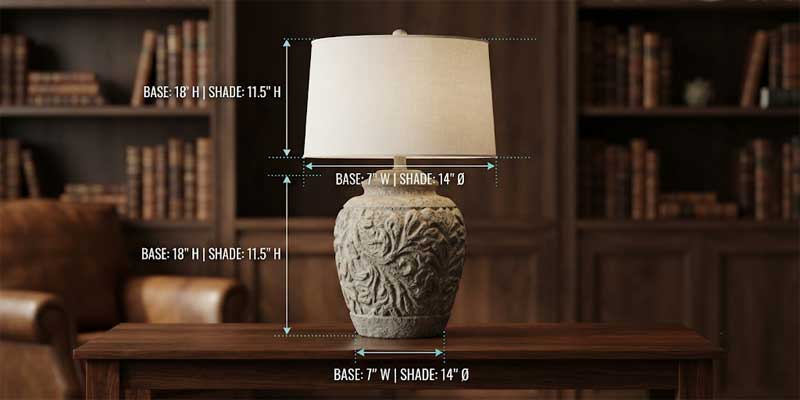
Measure the vertical height of your lamp base from the bottom of the footpad straight up to the bottom of the brass socket collar (do not measure to the top of the socket or the harp). The ideal shade height should measure approximately 60% to 70% (roughly two-thirds) of that base height dimension. For an 18-inch tall lamp body, choose replacement lamp shades with a vertical slant height between 11 and 12.5 inches.
2. The Bottom Diameter Formula (Two-Times Rule)
To determine the correct bottom spread, measure the widest horizontal cross-section of your lamp base. The bottom diameter of your replacement shade should measure roughly two times the width of the base. For example, a heavy ceramic jug lamp measuring 7 inches wide requires proportional lamp shades with a bottom diameter between 14 and 16 inches. The bottom rim must also be at least 1/2-inch wider than the base on both sides to prevent the composition from appearing pinched.
3. Eyeline Glare and Socket Concealment
Regardless of mathematical proportions, the functional test of any shade is whether it conceals mechanical hardware. When seated on nearby sofas or sitting up in bed, the lower rim of the shade should completely hide the socket, switch turn-knob, and harp saddle without forcing you to look directly at a bare, glaring bulb filament. When styling expansive seating layouts, integrating proportional Table Lamps For Living Room on substantial credenzas creates cohesive pools of indirect task light.
Thermal Safety: UL Critical Radius and Heat Clearance
Beyond aesthetics, functional lamp shades serve as essential thermal chimneys. Trapped heat from bulbs accelerates fabric dry-rot, scorches synthetic backing materials, and poses legitimate fire hazards. According to Underwriters Laboratories (UL) safety testing standards, every shade must maintain a minimum physical clearance—known as the Critical Radius—measured horizontally from the center of the bulb filament to the nearest combustible inner shade lining:
- Bulbs up to 40 Watts: Requires a minimum horizontal clearance of 2 inches.
- Bulbs 41 to 60 Watts: Requires a minimum horizontal clearance of 2-1/2 inches.
- Bulbs 61 to 100 Watts: Requires a minimum horizontal clearance of 3-1/2 inches.
- High-Output Bulbs (150 Watts): Requires at least 4-3/4 inches of clear chimney radius.
While modern LED bulbs generate substantially less forward radiant heat than obsolete incandescents, their sensitive thermal diode circuits require continuous vertical airflow. Narrow chimney lamp shades with tightly restricted top apertures trap warm air around the socket, accelerating driver degradation and causing premature LED bulb failure.
Material Light Distribution: Translucent vs. Opaque
The structural composition of a shade dictates how illumination disperses throughout a living space. Homeowners should choose materials based on room function rather than exterior color alone:
1. Translucent Fabrics (Linen, Cotton, and Softback Silk)
Softback shades feature fine outer fabrics stretched over inner vertical wire ribs and lined with semi-sheer white polyester or rayon. These materials diffuse light omnidirectionally through the side walls, brightening the perimeter of the room and reducing contrast shadows. Choose translucent linen or silk lamp shades for general ambient illumination in family gathering rooms, entry foyers, and bedside reading tables.
2. Opaque Hardbacks (Heavy Parchment, Cardstock, and Metal)
Hardback shades laminate paper, woven grass, or faux leather onto an insulative styrene backing. Because the walls block horizontal light transmission entirely, illumination is forced out exclusively through the top and bottom apertures. This creates dramatic pools of upward ceiling wash and downward downlight. Hardback parchment lamp shades with reflective interior gold foil linings are exceptional for focused desk work, corner conversation zones, or accenting artisanal consoles.
To explore an extensive catalog of artisanal bases, proportioned silhouettes, and tailored fixtures for every interior style, browse the full collection at Table Lamp.
Investing the time to measure your base height, verify harp clearance, and identify your socket fitter guarantees that your replacement lamp shades provide balanced proportion, certified electrical safety, and flawless room ambiance for decades.
