
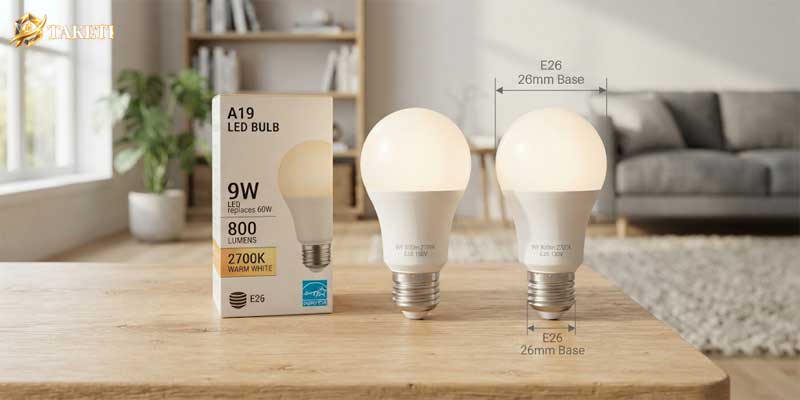
Standing in the home improvement lighting aisle confronted by a towering wall of modern led light bulbs has turned into one of the most frustrating shopping experiences in modern homeownership. For nearly a century, replacing a spent bulb was an intuitive, five-second errand. You picked up a cardboard two-pack of 60-watt or 100-watt incandescents, screwed them in, and enjoyed the exact same familiar, cozy golden illumination you had known your entire life. Today, when shopping for household led light bulbs, that simple chore has been replaced by a dizzying barrage of packaging terms, contradictory conversion claims, unexpected base threads, and confusing marketing labels that leave ordinary homeowners second-guessing every purchase.
The confusion is understandable. Countless homeowners bring home new led light bulbs that turn out to be blindingly cold and clinical, buzz violently when paired with a dining room wall dimmer, or unexpectedly burn out after merely seven months despite boasting a “15-year life” promise on the carton. Yet, behind this retail maze lies the most transformative lighting innovation of our time. High-efficiency LED Lights cut home electricity consumption by up to eighty-five percent, generate virtually zero dangerous surface heat, contain no toxic chemical elements, and can deliver exquisite illumination when chosen correctly. To take the mystery out of selecting quality led light bulbs, this practical guide cuts through the retail noise and provides everything you need to select the perfect bulb for every fixture in your home.
Energy Efficiency in Practice: Why LED Light Bulbs Rely on Lumens, Not Watts
The single greatest obstacle homeowners face when selecting led light bulbs is the stubborn habit of equating wattage with visual brightness. In historic incandescent technology, wattage performed double duty: it measured how much electricity flowed through the tungsten filament, and because filaments behaved predictably, it served as a reliable shorthand for how bright the room would appear. We all intuitively knew that a 40-watt bulb was gentle enough for an evening nightstand, a 60-watt bulb illuminated a bedside reading chair, and a 100-watt bulb flooded a basement or kitchen island.
With modern solid-state diodes found in today’s led light bulbs, that entire mathematical relationship is obsolete. Modern diodes convert electricity directly into light photons without relying on thermal resistance. Consequently, wattage on led light bulbs now measures only one thing: how much electrical current the bulb draws from your wall outlet. It tells you what it costs to operate, but offers virtually zero indication of how much light will fill your living room.
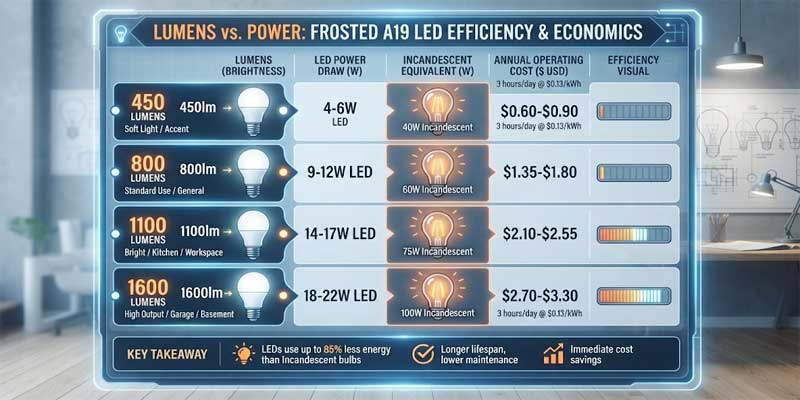
To determine actual visual brilliance in contemporary led light bulbs, you must look exclusively at the Lumen (lm) rating printed prominently on every box. Lumens quantify the total volume of visible illumination cast into an interior space. A classic 60-watt incandescent produced approximately 800 lumens of warm light. Today, standard A19 led light bulbs deliver that identical 800 lumens while consuming an astonishing 8.5 to 9 watts of electricity. The visual brightness delivered to your eyes is identical, but the electrical draw drops by over eighty-five percent.
| Familiar Incandescent Wattage | Actual Light Output (Lumens) | Modern LED Power Consumption | Estimated Annual Electricity Cost* | Recommended Placement in the Home |
|---|---|---|---|---|
| 40 Watts | 450 Lumens | 5W – 6W | $0.72 / year | Bedside nightstands, decorative credenza lamps, hallway wall sconces |
| 60 Watts | 800 Lumens | 8.5W – 10W | $1.20 / year | Living room end tables, dining table pendants, home office desk lamps |
| 75 Watts | 1,100 Lumens | 11W – 12.5W | $1.55 / year | Kitchen preparation counters, craft corners, deep reading armchairs |
| 100 Watts | 1,600 Lumens | 14W – 16W | $1.95 / year | Recessed ceiling fixtures, high-ceiling entry foyers, garages, utility basements |
| 150 Watts | 2,600 Lumens | 22W – 25W | $3.10 / year | High-bay garage workshop areas, outdoor security floodlights, driveways |
*Cost estimates calculated based on standard US average household electricity rates of 13 cents per kilowatt-hour, operating 3 hours per day, 365 days per year.
Consider the cumulative financial impact across an entire residence when switching to led light bulbs. The typical single-family American household features between 35 and 50 light fixtures. Running forty classic 60-watt incandescent bulbs for three hours daily consumes roughly 2,628 kilowatt-hours annually, costing approximately $340 to $420 every year purely to illuminate your home. Equipping those identical forty sockets with modern 9-watt led light bulbs cuts power usage to under 400 kilowatt-hours, dragging your yearly lighting expenditure down to under $50. Over five years, outfitting your household with efficient led light bulbs puts more than $1,500 back into your family budget without sacrificing a single drop of visual brightness.
Reading the Lighting Facts Label on Packaging for LED Light Bulbs
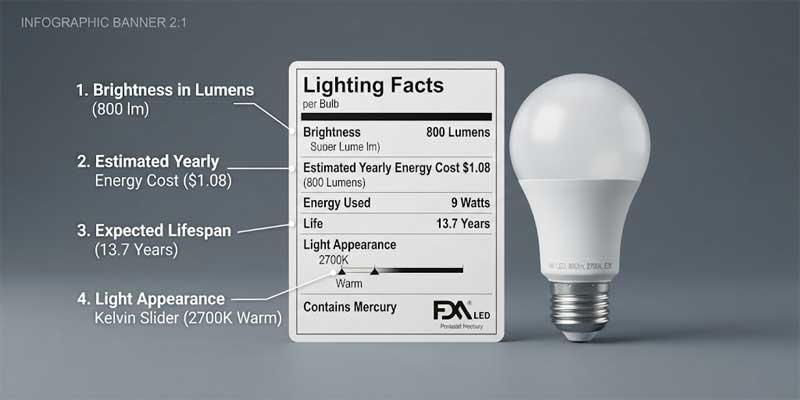
Just as the US Food and Drug Administration mandates nutritional labels on food products to protect consumers from misleading claims, the Federal Trade Commission (FTC) requires every manufacturer selling consumer bulbs in the United States to print an official Lighting Facts Label on the carton. When shopping for led light bulbs, most buyers look right past this clear graphic panel. Once you know how to decode its four primary data points, you will never buy the wrong led light bulbs again:
1. Brightness in Lumens
Always displayed at the very top in bold typography. If the number says 450 lm on your led light bulbs, you are holding a soft, 40-watt equivalent accent bulb. If it reads 800 lm, it is an everyday 60-watt equivalent workhorse. If it displays 1,600 lm, you are holding high-output led light bulbs designed for overhead illumination.
2. Estimated Yearly Energy Cost
This entry calculates what your led light bulbs cost to operate over an entire year based on three hours of daily usage at typical nationwide utility rates. For modern led light bulbs, this figure generally sits between $0.90 and $1.80 per year, compared to the $7.00 to $12.00 values traditionally printed on old incandescent stock.
3. Expected Operating Life
The label breaks down durability into both total operational hours and an everyday estimate in years based on three hours of use per day. An advertised 25,000-hour rating on quality led light bulbs translates to an impressive 22.8 years of regular domestic service.
4. Light Appearance Kelvin Slider
At the bottom of the label sits a horizontal gradient line marked with a numerical indicator indicating Kelvins (K). The slider moves from Warm (2700K) on the far left to Cool (6500K) on the far right. Checking this specific number on led light bulbs prevents the catastrophic error of purchasing a clinical blue daylight tone when you actually wanted a relaxing golden tone for your bedroom sanctuary.
Demystifying Sockets and Base Sizes for Residential LED Light Bulbs
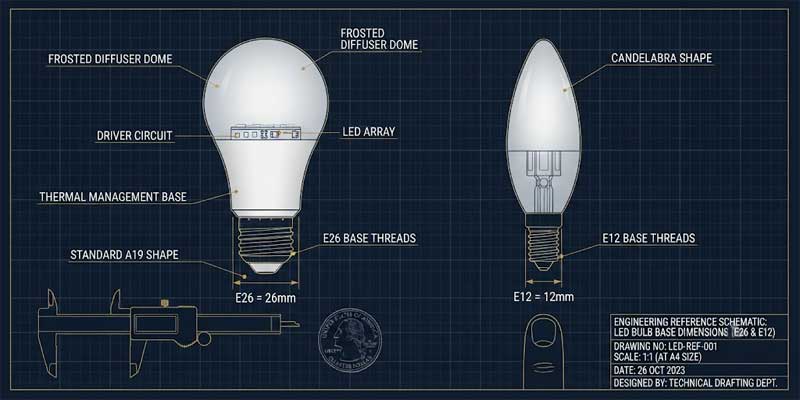
There is nothing more exasperating than unboxing replacement led light bulbs, reaching inside your favorite table lamp, and finding that the metallic threads simply will not seat into the socket. In North American residential lighting, led light bulbs fall into a handful of standardized mechanical sizes. Identifying your fixture’s socket takes less than ten seconds once you recognize the two dominant screw categories:
1. The E26 Medium Standard Base
Found inside roughly 90% of American household light fixtures, the E26 base (the “E” honors Thomas Edison, and “26” denotes a 26-millimeter threaded diameter) is the standard screw base used across everyday led light bulbs. As a quick visual rule of thumb, an E26 base measures roughly the exact diameter of a standard US quarter coin. This is the universal base specified for tabletop reading fixtures, sturdy floor standing lamps, flush-mount hallway ceilings, and exterior porch lights.
2. The E12 Candelabra Base
The second most prevalent base in residential design is the slender E12 Candelabra base, which features a narrow 12-millimeter threaded diameter (roughly the thickness of an adult’s pinky finger). Slender E12 led light bulbs are universally deployed in multi-socket dining room chandeliers, petite hallway wall sconces, holiday window candelabras, and compact nightstand fixtures where an oversized standard socket would compromise an artistic silhouette.
3. Specialty Twist-and-Lock Bases (GU10 and GU24)
In modern architectural track lighting, kitchen range hoods, and certain high-efficiency local building code fixtures (especially throughout California), you may encounter bi-pin twist-and-lock sockets instead of screw threads. A GU10 base features two small metallic nubs spaced 10 millimeters apart that slide into matching slots and lock with a quarter-turn. A GU24 base uses two wider, rounded prongs engineered specifically to ensure homeowners install dedicated high-efficiency led light bulbs into energy-certified architectural fixtures.
Bulb Shapes, Frosted Domes, and Aesthetic Decor Synergy
Choosing the correct bulb base guarantees that electricity will flow, but choosing the proper envelope dictates whether the finished fixture looks balanced. The shape of led light bulbs determines how light scatters through surrounding shade materials and whether the physical fixture maintains architectural proportion.
1. The Classic Frosted A19 Household Envelope
The ubiquitous teardrop pear shape that everyone pictures when imagining a light bulb is technically designated as an A19 (the “A” signifies Arbitrary household contour, and “19” indicates its widest diameter in eighths of an inch, or 2-3/8 inches wide). Standard A19 frosted led light bulbs represent the primary utilitarian choice for enclosed table lamps, drum floor fixtures, and desktop task lights where the bulb itself remains hidden behind a protective fabric shade.
2. Slender Candelabra Bulbs (B11 and CA10)
For delicate fixtures, petite wall sconces, and dining chandeliers, slender torpedo bulbs (B11) or bent-tip flame bulbs (CA10) are mandatory. Using slim candelabra led light bulbs prevents the bulb from protruding awkwardly beyond decorative crystal droplets or mini fabric clip-on shades.
3. Why Frosted Polycarbonate Domes Matter for Table Lamps
When selecting household led light bulbs, consider what type of shade covers the fixture. For fabric or paper shades—such as the artisanal designs found throughout the curated Table Lamp collection—always choose frosted white led light bulbs. Frosted envelopes scatter photon emission omnidirectionally, eliminating pinpoint hot spots and preventing ugly inner shadow bars from projecting onto your linen shade.
Color Temperature in Daily Living: Finding Comfort with LED Light Bulbs
Few lighting errors cause as much domestic distress as selecting the wrong color temperature for a living room or bedroom. Many shoppers unwittingly purchase led light bulbs labeled “Daylight,” expecting the warm, gentle radiance of an early summer morning sun. When they switch the lamp on at 8:00 PM, their cozy family room is suddenly washed in a cold, blue-white glare that feels like a walk-in freezer or an airport security checkpoint.
Color temperature is calibrated on the Kelvin (K) thermal scale. Lower numbers represent warm, amber tones, while higher numbers indicate crisp, cool, blue-white illumination. Mastering color allocation room-by-room ensures your home feels genuinely inviting:
1. Soft White (2700K): Restful Evening Ambiance
Calibrated between 2700K and 2800K, soft white led light bulbs produce a mellow, golden-yellow illumination identical to traditional incandescent filaments. This warm spectrum contains virtually zero high-frequency blue wavelengths, signaling your brain’s endocrine system that the workday is done. Soft white illumination flatters human skin tones, enriches natural hardwood finishes, and establishes a tranquil environment. It is the premier choice for bedside reading tables adorned with Bedroom Table Lamps and relaxing living room sanctuaries anchored by coordinated Table Lamps For Living Room.
2. Warm White (3000K): Crisp Modern Warmth
Slightly whiter than soft white, 3000K led light bulbs strip away heavy yellow undertones while retaining an underlying warmth. This temperature is exceptionally well suited for transitional and contemporary interiors featuring marble countertops, gray walls, white painted cabinetry, and brushed nickel hardware. It is the premier choice for dining rooms, kitchen island pendants, and open-plan living areas where you desire a crisp ambiance that never feels chilly.
3. Daylight (5000K): High-Focus Clarity
Daylight led light bulbs sit between 5000K and 6500K, casting an intense, icy-white beam with prominent blue undertones. Rather than mimicking early morning sunshine, daylight led light bulbs replicate the harsh, high-noon sky. This wavelength suppresses melatonin production, elevates focus, and maximizes edge-contrast perception. Reserve daylight bulbs strictly for practical work zones: home auto repair garages, basement workshops, laundry sorting stations, and utility spaces. For a deeper comparative breakdown, explore our detailed analysis of soft white vs daylight.
The Truth About Lifespan: Why LED Light Bulbs Fail Early and How to Stop It
Every consumer packaging card makes bold promises regarding extreme durability: “Lasts 15,000 Hours,” “15-Year Dependability,” or “10-Year Warranty.” Yet, countless homeowners find themselves tossing dead led light bulbs into the recycling bin after only eight or ten months. Does the lighting industry rely on exaggerated marketing claims?
The short answer is no; the diode chips inside led light bulbs can easily endure twenty thousand hours of continuous illumination. The component that fails is almost always the delicate internal electronic driver tucked inside the plastic collar directly above the metal screw base. Unlike incandescent bulbs that shed heat outward through infrared light waves, modern led light bulbs radiate thermal energy backwards into this internal driver assembly. When heat cannot escape, the electronic circuitry slowly cooks itself until a solder joint or tiny capacitor fails prematurely.
To ensure your household led light bulbs fulfill their multi-year lifespan potential, avoid these standard operational mistakes:
- Trapping Non-Enclosed Bulbs in Sealed Fixtures: Standard led light bulbs require ambient room air circulation to draw heat away from their base. Screwing an ordinary bulb into an airtight ceiling globe or sealed outdoor wall lantern creates an electronic oven. If your fixture is fully enclosed by glass, always check the packaging for the specific phrase “Enclosed Fixture Rated.”
- Restricting Airflow in Narrow Lamp Shades: Deep, narrow chimney shades with minimal top clearance trap superheated air directly above the base of led light bulbs. As detailed in our comprehensive guide to lamp shades, maintaining proper vertical clearance guarantees natural convective chimney ventilation, keeping the driver cool and extending operational life.
- Exposure to Excessive Humidity and Vibration: Standard led light bulbs installed directly beneath violent ceiling fans or in unvented shower enclosures experience premature solder degradation. In vibrating or high-humidity zones, specify damp-rated, heavy-duty commercial-grade options.
Dimmers, Flickering, and Incompatible Wall Switches for LED Light Bulbs
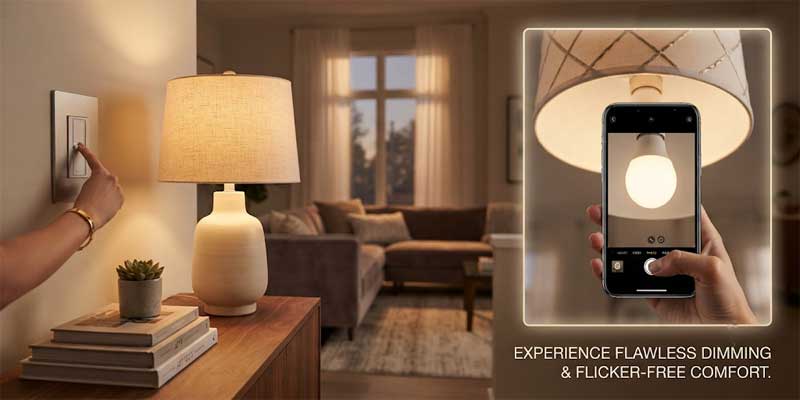
There are few domestic annoyances more aggravating than spending forty dollars upgrading your dining room chandelier with fresh led light bulbs, sliding your wall dimmer down for an intimate family dinner, and being greeted by a strobing horror show or a relentless, high-pitched electrical buzzing sound. This common glitch is not your fault; it is the natural consequence of mating solid-state microchips with older wall switches.
Traditional incandescent dimmers worked by mechanically chopping up the alternating electrical current wave, starving a high-wattage tungsten filament of voltage to make it glow dimmer. In contrast, modern led light bulbs house sensitive computer chips and rectifying drivers that require clean, steady electronic signals to maintain stable diode output.
To eradicate flickering and buzzing with led light bulbs permanently, follow these three rules:
- Always Buy Bulbs Labeled “Dimmable”: Never assume that all led light bulbs will dim automatically. Non-dimmable led light bulbs feature rigid internal drivers designed exclusively for steady, full 120-volt current. Feeding lower voltage into non-dimmable led light bulbs will cause rapid strobe flashing, loud buzzing, and catastrophic driver burnout within days.
- Upgrade Old Wall Switches to Modern LED Dimmers: If your home features rotary knob dimmers or older slider switches installed decades ago, they lack the low-wattage sensitivity to manage low-power led light bulbs. Upgrading your wall plate to a modern digital dimmer switch engineered specifically for low-voltage LED loads provides butter-smooth dimming down to 5% brightness with zero hum.
- Perform the “Smartphone Camera Test” for Invisible Eyestrain Flicker: Cheap, uncertified discount-store led light bulbs often utilize low-grade internal drivers that pulse on and off at frequencies invisible to conscious human vision, but rapid enough to cause persistent headaches and eye strain after an hour of reading. To test your led light bulbs, launch your smartphone’s camera app, point the lens directly at the illuminated bulb from two feet away, and switch to video or slow-motion mode. If you see dark, pulsating black bands rolling across your screen, the bulb suffers from severe driver ripple. Replace it immediately with certified, flicker-free led light bulbs designed with clean regulation circuitry.
Safety and Environmental Health: The Non-Toxic Advantage of LED Light Bulbs
Beyond tremendous energy savings and beautiful interior ambiance, transitioning your home to quality led light bulbs provides vital health and safety protections for your family and pets. For decades, environmentally conscious consumers were told to purchase compact fluorescent lamps (CFLs)—the ubiquitous spiral-corkscrew bulbs that dominated the early 2000s. What packaging fine print rarely emphasized was that every single CFL bulb contained pressurized gaseous mercury, a potent neurotoxin.
When an active child or playful pet accidentally knocked over a bedside lamp equipped with an old CFL bulb, the resulting clean-up required hazardous chemical protocol: opening windows for fifteen minutes, evacuating family members, shutting down the central HVAC system to prevent vapor recirculation, and meticulously collecting glass fragments with adhesive tape rather than a vacuum cleaner. With solid-state led light bulbs, that household nightmare is eliminated forever. Modern led light bulbs contain absolutely no mercury, lead, or hazardous chemical vapor. If a ceramic bedside lamp is tipped over, sweeping up a shatterproof frosted bulb requires nothing more than an ordinary broom and dustpan.
Furthermore, high-quality led light bulbs emit virtually zero ultraviolet (UV) or infrared (IR) radiation. Incandescent bulbs threw off massive amounts of radiant infrared heat, making desk lamps dangerous to touch and gradually scorching delicate fabric shades. Traditional halogens cast ultraviolet wavelengths that actively bleached expensive oil paintings, faded hardwood floor stains, and degraded linen window draperies over time. Modern led light bulbs generate light entirely within the safe, visible human spectrum, allowing you to showcase delicate heirloom tapestries, fine artworks, and artisanal designer shades with absolute peace of mind.
Transforming your home lighting from an unpredictable, frustrating chore into an inspiring design asset simply requires focusing on the facts that matter. By shopping for true brightness in lumens, matching your base threads, honoring your home’s natural rhythm with warm Kelvin temperatures, and selecting quality-certified dimmable options, you can effortlessly enjoy decades of flawless, energy-efficient comfort with modern led light bulbs in every corner of your home.

Pingback: LED Strip Lights: 7 Pro Rules to Install and Sizing Right